How to Become a Registered Nurse in Australia as an Overseas Nurse
How to become a registered nurse in Australia starts with the Ahpra online self-check, which tells you which registration pathway applies to you. If your qualification is relevant but not substantially equivalent, you complete the outcomes-based assessment. Stage 1 is the NCLEX-RN. Stage 2 is a clinical skills examination held in Adelaide. After both stages, you apply for registration and start your job search. (Source: Nursing and Midwifery Board of Australia, Outcomes-based assessment)
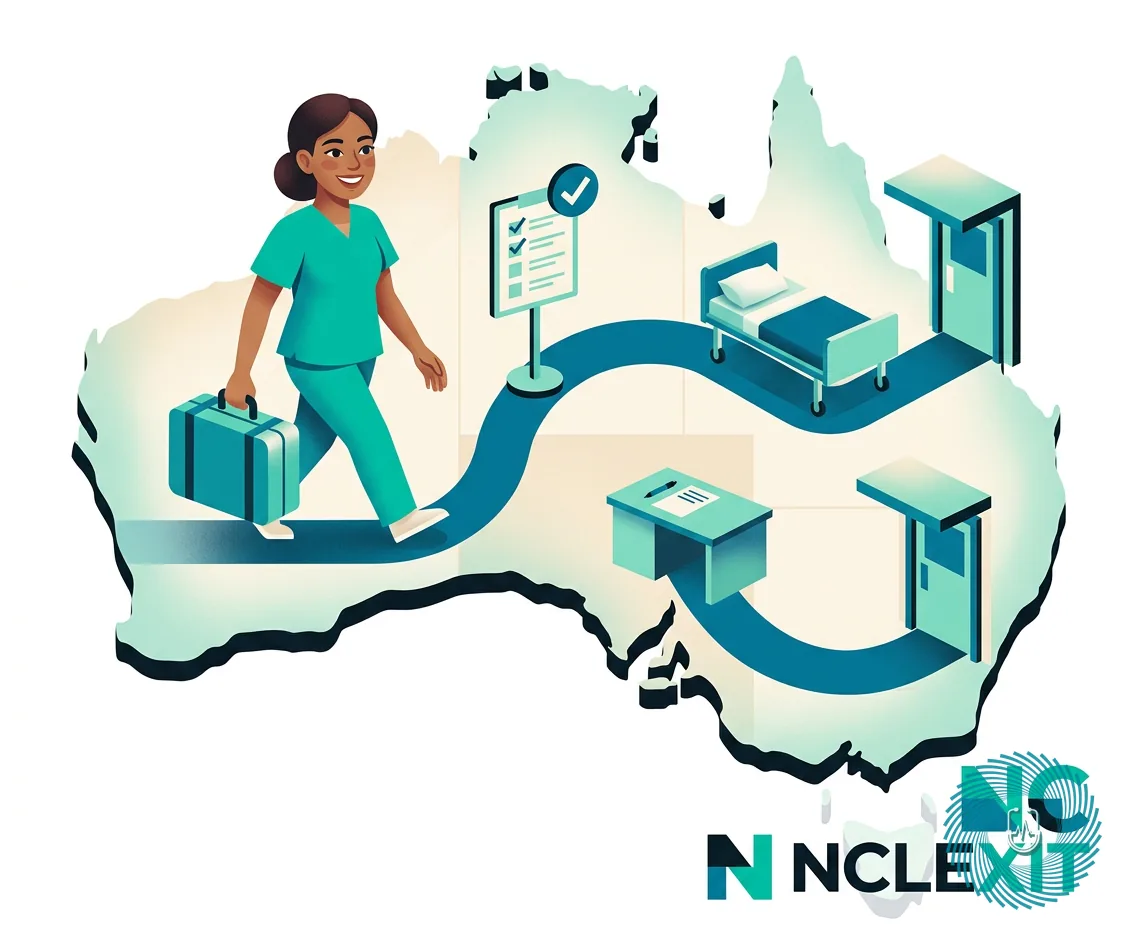
What is the route to becoming a registered nurse in Australia?
Many overseas nurses find the Australian process confusing at first. There are several bodies, several forms and more than one possible pathway. The good news is that the route follows a clear order once you know it.
Nursing registration in Australia runs through the Nursing and Midwifery Board of Australia (NMBA) and Ahpra. Ahpra is the national agency that handles applications. You do not choose your pathway yourself. The system sorts you into one based on your education and your registration history.
You start with Ahpra's online self-check. It decides which registration pathway applies to you. (Source: Nursing and Midwifery Board of Australia, Internationally qualified nurses and midwives) Some nurses are eligible for direct registration. Others must prove their skills first.
If your qualification is relevant but not substantially equivalent, you complete the outcomes-based assessment. Since 2020, that assessment has had two stages. Stage 1 is the NCLEX-RN. Stage 2 is an objective structured clinical examination, called an OSCE, held in Adelaide. (Source: Nursing and Midwifery Board of Australia, Outcomes-based assessment)
So the route for an overseas nurse has four parts:
- The Ahpra self-check
- The two assessment stages
- Registration with the Board
- Your first nursing job
Each part has its own paperwork and its own risk of delay. Knowing them early lets you plan your time and your money.
Why the Australian registration route matters in 2026
Getting the order right saves months. A nurse who skips the self-check may prepare for the wrong exam. A nurse who books the OSCE before passing stage 1 may lose fees and time.
The pathway matters because it sets your assessment burden. Some nurses need no exam at all. Others must pass the NCLEX-RN and then a practical test. The self-check is the only reliable way to learn which group you are in. (Source: Nursing and Midwifery Board of Australia, Internationally qualified nurses and midwives)
The NCLEX-RN is a computer adaptive test. Under the NCSBN rules in use since April 2023, it runs 85 to 150 items over 5 hours. (Source: NCSBN) The exam is built around clinical judgment, not recall alone. That suits nurses who already think in cases. The format still needs practice.
Australian candidates take the NCLEX-RN under the same test plan as American candidates. For more on how this works on the Australian pathway, read our guide to the NCLEX for the Australian OBA.
Planning also matters for your career. Your registration date sets your start date. Employers hire nurses who can work now. A clean, ordered application helps you reach your first job sooner. Treat how to become a registered nurse in Australia as a project with milestones. That keeps you in control.
Step-by-step: how to approach registration as an overseas nurse
Step 1: Complete the Ahpra self-check
Go to the Ahpra website and take the online self-check. It asks about your education, your registration and your work history. The result tells you which pathway applies. Save a copy of the result. Prepare certified copies of your degree, transcripts and registration records before you move on.
Step 2: Confirm whether you need the outcomes-based assessment
If your qualification is relevant but not substantially equivalent, you must complete the outcomes-based assessment. (Source: Nursing and Midwifery Board of Australia, Outcomes-based assessment) If the self-check points elsewhere, follow that pathway instead. Do not assume. Read the Board's guidance for your exact result.
Step 3: Prepare for and sit the NCLEX-RN (stage 1)
Stage 1 is the NCLEX-RN. Build a study plan around the client-need categories and Next-Generation NCLEX item types. Use a diagnostic test early to find weak areas. Then practise unfolding case studies that follow the six steps of the NCSBN Clinical Judgment Measurement Model. Full mock exams help you manage the 5-hour clock. (Source: NCSBN) Our NCLEX study notes can help you organise what to review.
Step 4: Prepare for the OSCE in Adelaide (stage 2)
Stage 2 is an objective structured clinical examination held in Adelaide. (Source: Nursing and Midwifery Board of Australia, Outcomes-based assessment) Practise speaking through your care aloud. Rehearse communication, safety checks and handover. Spoken practice with an AI-played client can help you hear your own gaps.
Step 5: Apply for registration
After you meet the assessment requirements, apply for registration through Ahpra. Have your identity documents, English language evidence and criminal history checks ready. Missing documents are a common cause of delay.
Step 6: Start your job search
Begin looking for work before your registration finishes. Tailor your r\u00e9sum\u00e9 to Australian formats. Practise a spoken interview for a new-graduate or transition role. A clear story about your overseas nursing experience helps employers see your fit.
Common mistakes to avoid on the way to registration
Most delays come from a few repeated errors. Avoid these and your path gets smoother.
Skipping or rushing the self-check
Some nurses guess their pathway from friends' stories. Your result may differ from theirs. The wrong pathway can mean months spent preparing for the wrong step. Take the self-check first and follow its result. (Source: Nursing and Midwifery Board of Australia, Internationally qualified nurses and midwives)
Treating the NCLEX-RN as a memory test
The NCLEX-RN measures clinical judgment. Candidates who only memorise facts often struggle with case-based items. Practise the six steps: recognize cues, analyze cues, prioritize hypotheses, generate solutions, take action and evaluate outcomes. Our guide on delegation and prioritization shows how these skills appear in questions.
Underestimating the OSCE
A strong written score does not mean an easy practical exam. The OSCE tests what you do and say at the bedside. Many candidates underprepare for spoken communication. Practise aloud, not only in your head.
Leaving paperwork until the end
Certified documents, English evidence and checks take time to collect. Start them while you study. A late document can hold up the whole application.
Waiting to plan the job search
Do not leave your r\u00e9sum\u00e9 and interview practice until after registration. Prepare in parallel. This keeps the gap between registration and your first shift short.
Expert insight and what changes next
Think of the route as two tracks that run together. One track is the formal process: self-check, assessment, registration. The other is your readiness: exam skills, spoken confidence and job preparation. Nurses who work both tracks at once tend to move more smoothly.
For the written stage, choose preparation that matches the real exam. Look for a bank of Next-Generation NCLEX style questions, adaptive sessions and full mock exams on the official category weightings. NCLEXIT offers 4028 practice questions and 52 unfolding case-study scenarios. (Source: NCLEXIT production data) If you are comparing options, see our review of NCLEX prep apps.
For the practical stage, voice practice builds the habit of thinking aloud. NCLEXIT includes 130 voice scenarios, each tested offline before release. (Source: NCLEXIT production data) You speak with an AI-played client or colleague. You then receive coaching on a clinical-judgment rubric.
Rules and fees can change. Check the Board and Ahpra websites for current requirements before you pay for anything. Treat the official pages as the final word on the route.
Finally, protect your energy. The process is long, and steady weekly effort beats short bursts. A clear plan, early paperwork and regular practice help you arrive at your first Australian shift ready and calm.
Frequently asked questions
What is the first step for an overseas nurse who wants to register in Australia?
Take Ahpra's online self-check. It decides which registration pathway applies to you. (Source: Nursing and Midwifery Board of Australia, Internationally qualified nurses and midwives)
What are the two stages of the outcomes-based assessment?
Stage 1 is the NCLEX-RN and stage 2 is an objective structured clinical examination (OSCE) held in Adelaide. Both apply to nurses whose qualification is relevant but not substantially equivalent. (Source: Nursing and Midwifery Board of Australia, Outcomes-based assessment)
Do all overseas nurses have to sit the NCLEX-RN?
No. Your self-check result decides your pathway, and only some nurses are sent to the outcomes-based assessment. Follow the result you receive rather than assuming.
How long is the NCLEX-RN?
It has between 85 and 150 items and runs up to 5 hours, including optional breaks. (Source: NCSBN)
Can I practise for the OSCE at home?
Yes. Rehearse communication, safety checks and handover out loud, ideally with a partner or an AI-played client. Spoken practice shows gaps that silent study can hide.
Get new insights as they publish
One evidence-checked article at a time, plus a free-trial link. No sequence, one click unsubscribes.