How to Pass the NCLEX on the First Try: A Sequenced Plan From ATT to Exam Day
The most reliable way to approach how to pass the nclex on the first try is to study for the way the exam scores you. The NCLEX-RN is a computer adaptive test that estimates your ability after every item. Start with a diagnostic. Build a four-to-eight-week plan around weak areas. Then practise the six clinical judgment steps.

What is the plan for passing the NCLEX-RN on the first try?
Most candidates treat the exam as a content test. They read, memorise, and hope. The NCLEX-RN does not work that way. It is a computer adaptive test, often called the CAT. It checks whether your ability sits above the passing standard.
After each item, the CAT updates its estimate of your ability. Then it picks the next item near that estimate. Correct answers lead to harder items. A miss leads to easier ones.
The exam also tests clinical judgment directly. Since April 2023, it uses the Next-Generation format, with three unfolding case studies of six items each.
The NCSBN Clinical Judgment Measurement Model has four layers. Its six cognitive skills all sit in layer 3. We call them steps 1 to 6: recognize cues, analyze cues, prioritize hypotheses, generate solutions, take action, and evaluate outcomes.
So the real problem is not how much to study. It is how to build safe, repeatable reasoning for up to five hours.
Why passing the NCLEX-RN on the first try matters in 2026
A first attempt matters for practical reasons. You cannot work as a registered nurse until you are licensed. Every retake adds waiting, cost, and stress.
The NCLEX registration fee for U.S. licensure is $200 USD (Source: NCSBN, nclex.com Fees & Payment page). That excludes your state board fee and prep costs. Canadian candidates work with provincial colleges, so check your regulator first.
Know the exam's shape before you plan. The NCLEX-RN has a minimum of 85 items and a maximum of 150 (Source: NCSBN). Fifteen are unscored pretest items. You get 5 hours (Source: NCSBN), with optional breaks at about two and three and a half hours.
Three stopping rules apply: 95% confidence, maximum length, and running out of time (Source: NCSBN, NCLEX-RN Test Plan). Stopping at item 85 does not by itself mean you passed or failed.
Time is a real risk. Run out of time before answering 85 items and you do not pass. If time runs out after 85, you pass only if your ability estimate stayed above the standard for each of the last 60 items.
Scoring varies by format. Multiple choice and bow-tie boxes score 0 or 1. Select-all-that-apply items use plus-or-minus scoring with a floor of zero. Rationale items give credit only when the linked parts are right together.
If you do not pass, you receive the Candidate Performance Report. It rates each client-need area as above, near, or below the standard.
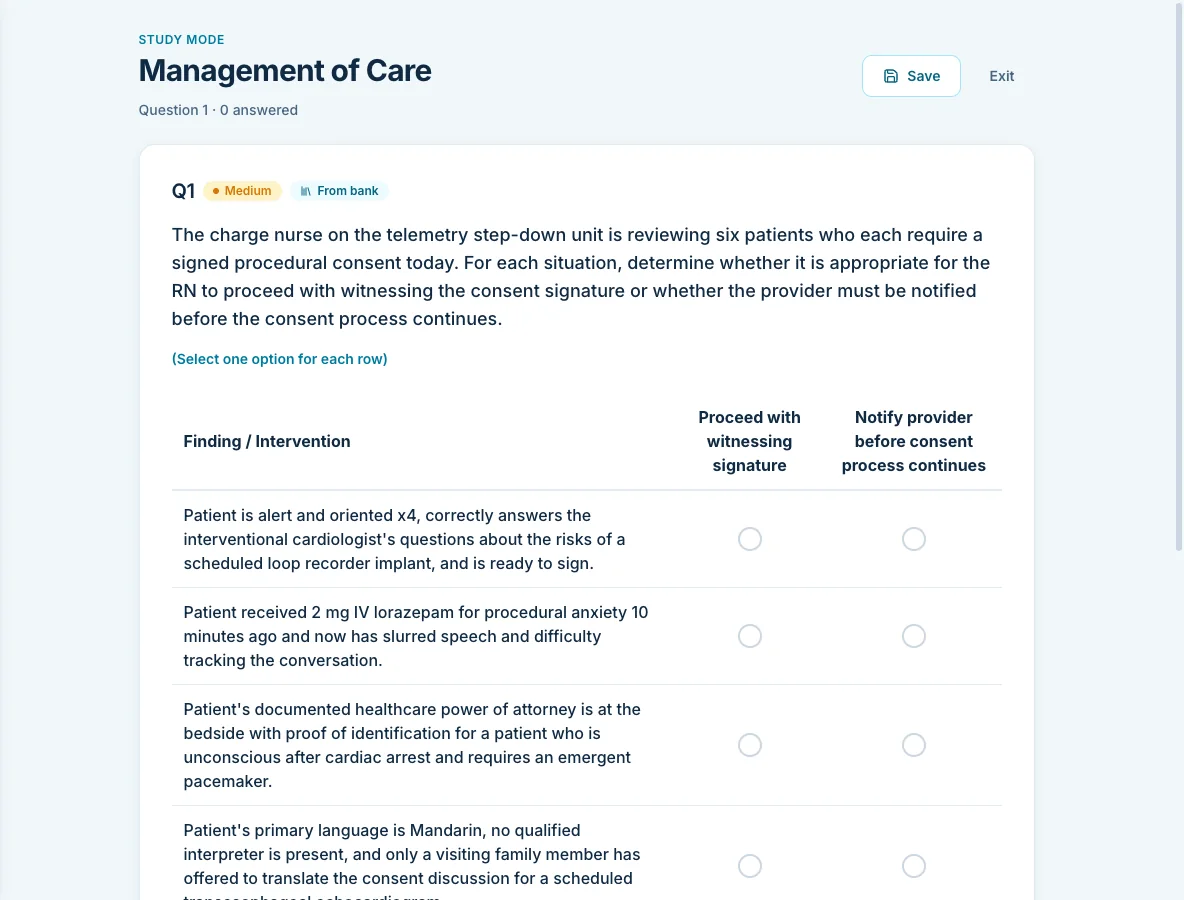
Step-by-step: how to pass the NCLEX on the first try
This plan runs from your Authorization to Test (ATT) to exam day. Adjust it to four, six, or eight weeks based on your diagnostic. For a deeper schedule, see our NCLEX study plan guide.
Step 1: Register and get your ATT date
Register with NCSBN and apply to your state board or provincial college. Book your exam once your ATT arrives. A fixed date turns vague intent into a countdown. Canadian candidates should read our guide for Canadian candidates first.
Step 2: Take a diagnostic exam
Before you study, test yourself. A diagnostic shows which client-need areas sit near or below the standard. It also shows whether your problem is content, speed, or reasoning.
Step 3: Choose a plan length
Pick four, six, or eight weeks. Shorter plans suit strong diagnostics and open schedules. Longer plans suit content gaps or heavy work hours.
Step 4: Practise the six clinical judgment steps
Do not just answer questions. Name which step each item tests. Steps 1 and 2 ask what the data mean. Step 3 asks which problem comes first. Steps 4 to 6 ask what you do and how you know it worked. Unfolding case studies follow the same flow.
Step 5: Drill prioritisation and delegation
Many missed items are priority errors, not knowledge gaps. Practise ranking by airway, breathing, circulation, and safety. Learn which tasks you can delegate. Our delegation and prioritization guide covers the rules.
Step 6: Review every wrong answer and every lucky guess
For each miss, write why the right answer wins and why yours lost. Review correct guesses too, since a lucky guess hides a gap. Pharmacology flashcards on spaced repetition help facts stick.
Step 7: Sit full mock exams
In the last two weeks, run full mocks of 85 to 150 items on a five-hour clock. Practise your pacing and a break at about two hours. Stamina is a skill.
Step 8: Taper and protect your sleep
In the final two days, stop heavy new content. Skim your notes, rest, and confirm your travel and ID. Then answer each item as if it were your only client. That is how to pass the NCLEX on the first try, one item at a time.
Common mistakes to avoid
Most first-attempt problems come from a short list of habits. Each one is fixable if you catch it early.
Studying content only
Reading chapters feels productive. But the exam asks you to apply facts to a client whose situation is changing. Without practice in clinical judgment, you build knowledge you cannot use under pressure.
Chasing the item count
Candidates often panic when the exam stops at 85 or runs to 150. Item count does not tell you the result. Stay on the item in front of you.
Spending too long on one item
Time is a stopping rule. Running out of time before 85 items means you do not pass. Practise a pace that finishes comfortably. If you are stuck, pick the safest option and move on.
Ignoring weak areas and skipping full-length practice
It is natural to practise what you already do well. But weak areas hold the points, so give them the most time. Short quizzes do not train for five hours. Do not first meet the five-hour clock on the real exam.
Memorising answers and choosing poor questions
If you only recall that an answer was right, a reworded item can beat you. Ask why, every time. Badly written questions also give false confidence. Our NCLEX question quality guide explains what to look for.
Expert insight and what changes next
A nurse educator would say the exam rewards safe, ordered thinking. Strong candidates know what to check first, what to do next, and when to call for help.
Consider a clinical example. Early signs of rising intracranial pressure are changes in level of consciousness, such as restlessness or confusion, and headache. A widening pulse pressure is a late sign. Cushing's triad is widening pulse pressure, bradycardia, and irregular respirations. It also comes late. A candidate who waits for the triad has missed the early cues.
This is steps 1 and 2 of the model at work. You recognize the early cue, then analyze what it means. Judgment also covers behaviour. If a staff nurse suspects an impaired colleague, the nurse reports immediately to the charge nurse or supervisor.
Tools can help you rehearse. NCLEXIT offers a diagnostic exam, adaptive study sessions, and a bank of 4028 practice questions (Source: NCLEXIT production data). It also has 52 unfolding case-study scenarios inside a patient chart, each with six questions (Source: NCLEXIT production data). A 24/7 AI tutor answers questions as they come up. See our AI NCLEX tutor overview.
For speaking practice, there are 130 voice scenarios (Source: NCLEXIT production data). You talk with an AI-played client or colleague and get scored on a judgment rubric. Each scenario has a recorded discrimination index. It shows how well that scenario separates safe from unsafe responses in pre-release testing. The mean is 61.1 (Source: NCLEXIT production data). That index describes the scenarios only.
No tool or plan can promise an outcome. A good plan gives you honest feedback early, while there is still time to act.
Frequently asked questions
How long should I study before taking the NCLEX-RN?
Most plans run four, six, or eight weeks after your ATT. Let your diagnostic results and work schedule set the length.
Does the exam stopping at 85 questions mean I passed?
No. Stopping at 85 does not by itself mean pass or fail. The exam stops at 95% confidence, at maximum length, or when time runs out (Source: NCSBN).
What happens if I run out of time on the NCLEX-RN?
Run out of time before 85 items and you do not pass. If time runs out after 85, you pass only if your ability estimate stayed above the standard for the last 60 items.
How much does it cost to register for the NCLEX-RN?
The registration fee for U.S. licensure is $200 USD (Source: NCSBN, nclex.com Fees & Payment page). Your state board or provincial college charges separate fees.
Should I take full-length mock exams?
Yes. Full mocks of 85 to 150 items on a five-hour clock train pacing and stamina. Schedule them in your last two weeks.
Get new insights as they publish
One evidence-checked article at a time, plus a free-trial link. No sequence, one click unsubscribes.