NCLEX 85 Questions Meaning and CAT Stopping Rules

What Is NCLEX 85 Questions Meaning? (The Problem)
Finishing an exam at minimum length creates intense stress. Many candidates leave testing centres wondering if they passed or failed. You might replay difficult case studies in your head. You might worry about tricky pharmacology items from the end.
The exam uses computer adaptive testing, known as CAT. CAT adjusts item difficulty based on previous answers. If you answer an item correctly, the next item is harder. If you answer incorrectly, the system presents an easier item. The system constantly estimates your ability relative to the passing standard.
The minimum length for the NCLEX-RN is 85 items. The maximum length is 150 items. When the screen stops at item 85, the algorithm has reached a decision. It has measured your ability with high precision. Stopping at 85 does not by itself mean pass or fail. It simply means the software has enough evidence.
Understanding the nclex 85 questions meaning helps reduce test anxiety. You can wait for official results with peace of mind. Both Canadian candidates waiting on provincial colleges and American candidates waiting on state boards experience the exact same CAT scoring logic.
Why NCLEX 85 Questions Meaning Matters in 2026 (The Data)
The Next-Generation NCLEX measures your clinical judgment across six steps. The exam tests whether you can recognize cues and analyze cues. It tests whether you can prioritize hypotheses and generate solutions. Finally, it tests whether you can take action and evaluate outcomes. These steps appear in unfolding case studies and standalone items.
The testing engine applies three distinct stopping rules during every test (Source: NCSBN CAT Guidelines):
- 95% Confidence Interval Rule: The test ends when the computer reaches 95% certainty about your ability (Source: NCSBN CAT Guidelines). This rule serves as the primary trigger for the 85-question shutdown.
- Maximum-Length Rule: If your ability stays very close to the standard, testing continues until item 150. At that point, your final ability estimate determines the result.
- Run-Out-of-Time Rule: A candidate who runs out of time before 85 items does not pass. If time runs out after 85, you pass only if your ability stayed above the standard for the last 60 items.
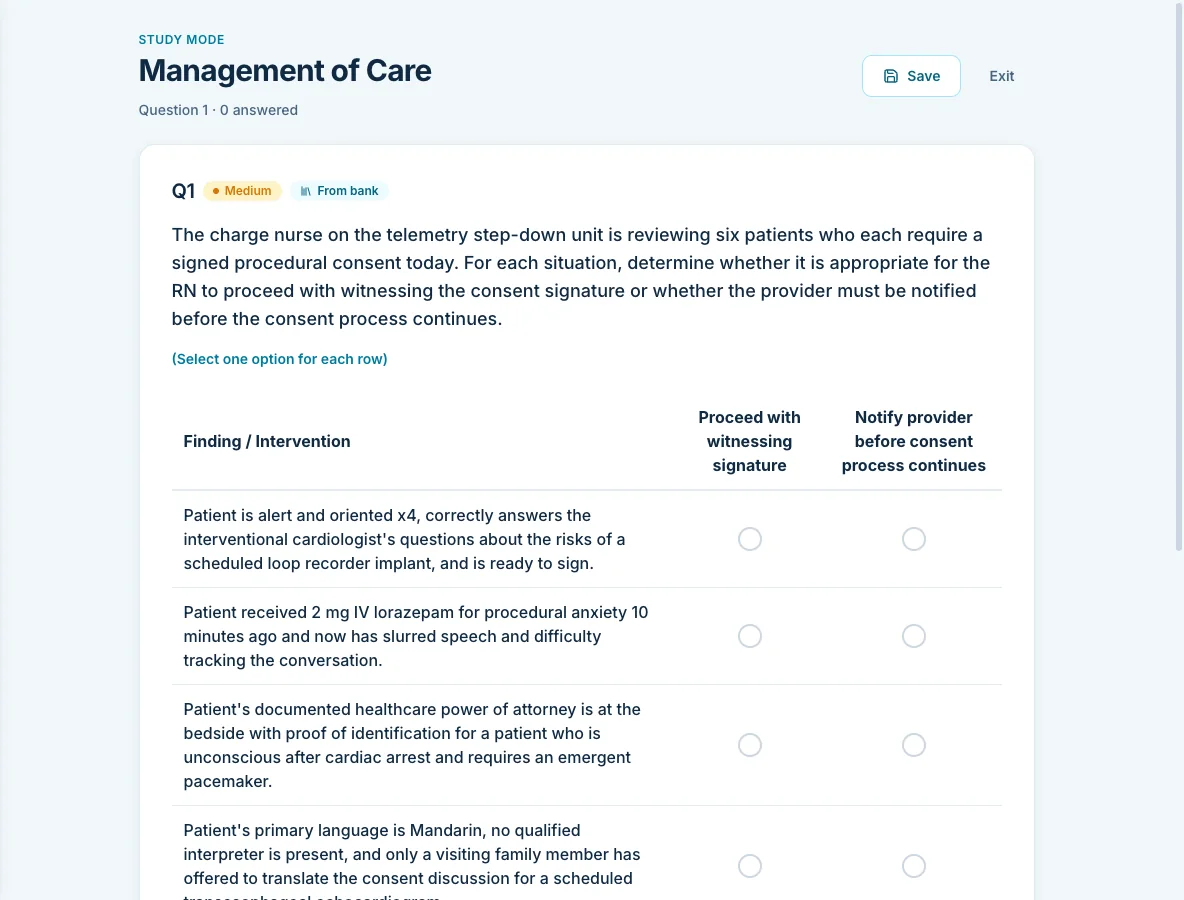
Practicing with full-length simulations builds mental stamina for any test length. NCLEXIT mock exams run 85 to 150 questions on official category weightings with a 5-hour clock. Our platform includes adaptive study sessions and a bank of Next-Generation NCLEX style practice questions (Source: NCLEXIT product specifications). Working through realistic charts prepares you to handle unpredictable exam lengths without panic.
Step-by-Step: How to Approach NCLEX 85 Questions Meaning (The Solution)
You cannot control when the computer stops your exam. However, you can control your mental preparation and pacing. Follow these steps to navigate the CAT environment safely.
Step 1: Treat Every Item as Your First
Do not try to estimate item difficulty while testing. Candidates often misjudge whether an item is hard or easy. Treat each client scenario on its own terms. Focus entirely on the immediate clinical cues.
Step 2: Pace for 150 Questions
Never enter the exam room expecting an early stop. Understanding the full nclex 85 questions meaning requires preparing for all 150 items. Mental fatigue can strike hard if the exam continues past question 85. Build your pacing plan around the full 5-hour clock. If you practice using a structured nclex study plan, you will maintain focus across five hours.
Step 3: Analyze Case Scenarios Systematically
Case studies carry multiple scoring opportunities through partial credit. Review the nurse notes, vital signs, and lab values carefully. Look for trends rather than isolated numbers. Base your nursing interventions on the most urgent client risk.
Step 4: Master Safe Prioritization
The exam places heavy emphasis on safety and infection control. Strengthen your ability to triage unstable clients using our nclex delegation prioritization review. Identifying which client requires immediate assessment keeps your ability estimate above the passing standard.
Step 5: Trust the Scoring Engine
When the screen shuts off at 85, take a slow breath. An early stop simply means the algorithm gathered enough evidence. Resist the urge to search online forums for unofficial prediction tricks.
Common Mistakes to Avoid (The Warning)
Post-exam rumination causes unnecessary stress. Candidates frequently jump to false conclusions about their test performance based on common myths.
A major error is assuming that an 85-question finish indicates an automatic failure. Many candidates feel they guessed on their last few questions. Remember that CAT presents items matching your current ability level. When you perform well, the items feel difficult because the system tests your upper limit. Feeling challenged at the end of an 85-item test is completely normal.
Another common mistake is trying to track item formats. Some candidates believe that getting fewer select-all-that-apply items means their score is dropping. The CAT algorithm selects items based on content categories and item difficulty. Apart from the three fixed case studies, it does not use item-format quotas. Counting specific question types only distracts you from applying clinical judgment.
Avoid attempting unofficial website tricks or score checks. These workarounds create needless anxiety. They can misinterpret temporary server flags. For candidates preparing under Canadian rules, see our guide on nclex for canadian candidates for accurate regulatory details.
Expert Insight and What Changes Next (The Authority)
Licensure preparation requires more than passive memorization. Modern nursing practice demands real-time verbal communication and dynamic risk assessment. Developing strong clinical judgment helps candidates prepare for licensure.
To prepare candidates for high-stakes clinical interactions, NCLEXIT offers spoken simulation. In the voice clinical simulation, the candidate speaks with an AI-played patient or colleague. The system coaches and scores responses on a clinical-judgment rubric. Every scenario is minted offline through a five-gate pipeline. This pipeline records a discrimination index before a student sees the scenario (Source: NCLEXIT production data). The discrimination index measures how well a scenario separates safe responses from unsafe responses in pre-release testing (Source: NCLEXIT production data).
Whether your test finishes at 85 questions or extends to 150 questions, the core standard remains the same. You must demonstrate consistent, safe nursing judgment. Calibrate your baseline knowledge early. Review core pharmacology on spaced repetition. Practice realistic unfolding charts to build total confidence on test day.
Frequently asked questions
What does it mean if my NCLEX-RN stops at 85 questions?
It means the adaptive algorithm reached 95% certainty about your ability (Source: NCSBN CAT Guidelines). Stopping at 85 does not by itself mean pass or fail.
Is stopping at 85 questions a good or bad sign?
It is neither inherently good nor bad. It simply confirms that the computer needed only the minimum number of items to make a final statistical decision.
Why did my exam feel so hard if I was doing well?
Computer adaptive testing gives harder questions when you answer correctly. A difficult test experience usually means you were answering high-level items.
How long do I have to complete the NCLEX-RN?
Candidates have up to 5 hours to complete the exam. This time limit applies whether your test stops at 85 questions or goes to 150 questions.
Get new insights as they publish
One evidence-checked article at a time, plus a free-trial link. No sequence, one click unsubscribes.