NCLEX Candidate Performance Report Interpretation: A Diagnostic Guide

What is nclex candidate performance report interpretation? (The Problem)
Receiving an unsuccessful result on the NCLEX-RN is discouraging. Many candidates react by buying fresh question banks. Then they restart their prep from page one. This generic approach wastes valuable study time. It treats every subject with equal weight instead of fixing specific gaps.
An accurate nclex candidate performance report interpretation gives you an objective breakdown of your exam. The National Council of State Boards of Nursing (NCSBN) issues this document. Provincial regulatory colleges in Canada provide it as well. It goes only to candidates who do not pass. The report provides two key pieces of data. It shows the total items delivered. It also reveals your performance level across each client-needs area.
Repeat candidates often repeat the same errors without this feedback. A candidate might spend weeks memorizing pediatric milestones. Yet they may fail because of weak safe and effective care management. This document reveals unaddressed clinical deficits. Decoding your report helps you move from unstructured review to targeted remediation.
Why nclex candidate performance report interpretation matters in 2026 (The Data)
Computerized adaptive testing measures your ability against a fixed standard. The test ends when the algorithm reaches 95 percent certainty about your ability (Source: NCSBN). Your report reflects how your answers performed across the official test plan categories.
The CPR classifies your performance in each category into three clear ratings. These are Above, Near, or Below the Passing Standard. Candidates who stop at 150 items stayed close to the passing threshold throughout their exam. Failing candidates who stopped at 85 items performed clearly below the overall passing standard.
Targeting specific weaknesses is vital for internationally educated nurses (IENs) and repeat candidates. Standard study schedules often overlook jurisdictional differences in scope of practice. You can structure your timeline using a focused nclex study plan that addresses the exact categories flagged in your report.
Modern prep tools allow you to align remediation directly with your report results. NCLEXIT maintains 4028 practice questions in the bank (Source: NCLEXIT production data). In addition, candidates have access to 52 unfolding case-study scenarios mapped directly to clinical judgment steps (Source: NCLEXIT production data).
Step-by-step: how to approach nclex candidate performance report interpretation (The Solution)
Follow these structured steps to turn your report into an actionable study protocol.
Step 1: Check your total item volume
Look at the total number of items delivered on your exam. A minimum-length exam of 85 items shows that the computer quickly established your ability. A maximum-length exam of 150 items means your performance stayed near the passing line until the end.
Step 2: Isolate categories below the standard
Identify every category marked Below the Passing Standard. These areas represent clear deficits in safe practice. For instance, low scores in Management of Care point to poor mastery of assignment and legal rights. Review our dedicated guide on nclex delegation prioritization to strengthen this critical domain.
Step 3: Analyze categories near the passing standard
Examine all sections marked Near the Passing Standard. Many candidates ignore these areas. They assume these scores are safe. That is a dangerous mistake. Because these areas sit right on the line, a tiny drop on your next attempt will lower your score.
Step 4: Audit your clinical judgment steps
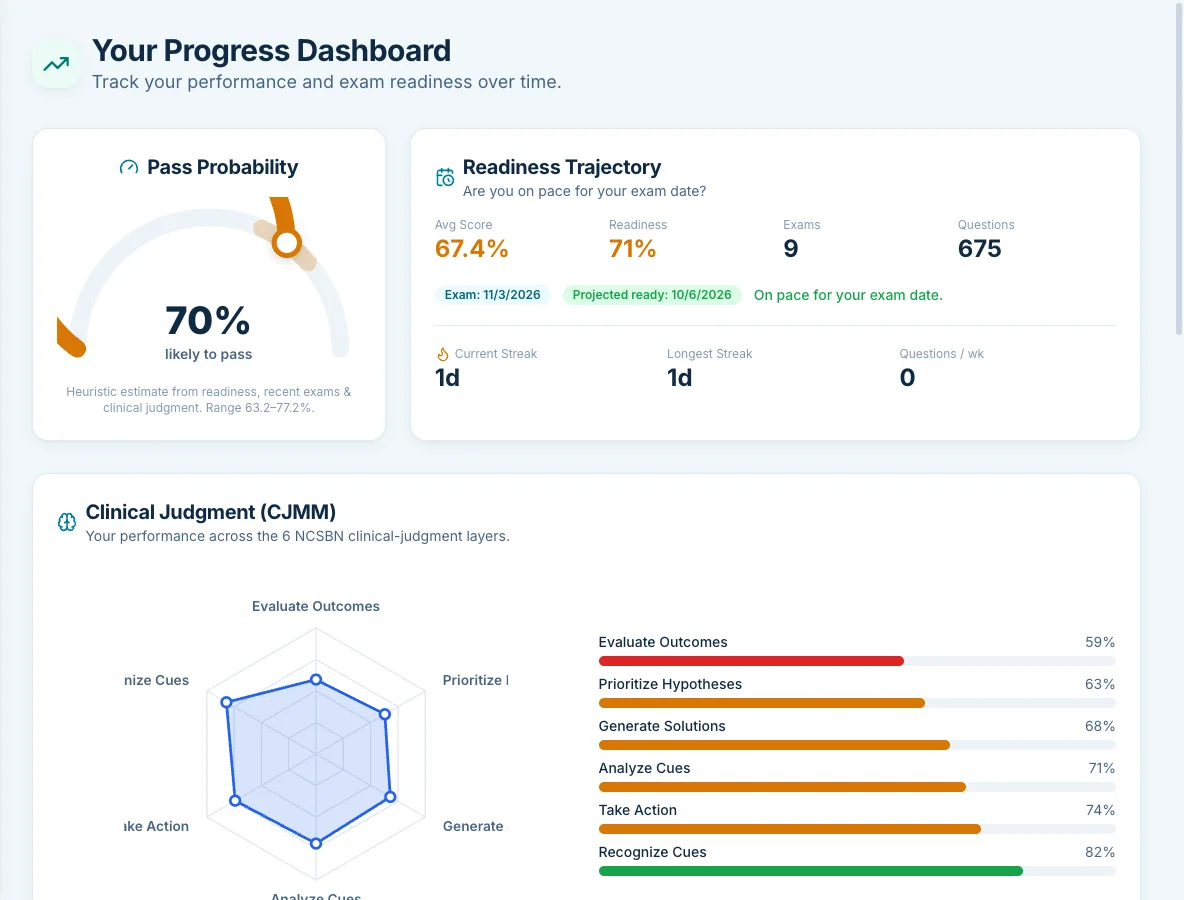
Next-Generation NCLEX items evaluate the six steps of the Clinical Judgment Measurement Model. Review whether your weak areas were factual or analytical. Practice analyzing cues, prioritizing hypotheses, and evaluating outcomes using unfolding charts rather than isolated questions.
Step 5: Practice high-discrimination clinical simulations
Engage in realistic voice-based scenarios to build rapid clinical decision-making skills. NCLEXIT provides 130 voice scenarios with a recorded discrimination index (Source: NCLEXIT production data). These interactive scenarios maintain a 61.1 mean discrimination index across voice scenarios to verify safe clinical decision-making (Source: NCLEXIT production data).
Common mistakes to avoid (The Warning)
The most common error after receiving a CPR is adopting a generic study approach. Re-reading an entire review book from start to finish does not fix analytical errors. You must spend most of your time on the client-need areas where you scored below the line.
Another frequent mistake is neglecting categories rated above the standard. Candidates often stop practicing their strong subjects entirely. Over several weeks, their recall in those strong areas degrades. You should maintain active recall across all domains while spending extra hours on weak categories.
Candidates also misunderstand the rating Near the Passing Standard. It does not mean you barely passed that section. It means your performance was too close to the line for the computer to verify competence. Treating near as a passing score creates false confidence.
Finally, avoid practicing only static recall questions. The NCLEX-RN requires candidates to recognize cues and take safe action within client scenarios. If you only practice simple recall, you will struggle when complex chart data appears on test day.
Expert insight and what changes next (The Authority)
Effective nclex candidate performance report interpretation bridges the gap between test failure and targeted remediation. The NCSBN designed the CPR as a diagnostic roadmap. Regulatory bodies expect candidates to use this data to remediate knowledge gaps before booking a re-test.
Canadian candidates should note how provincial nursing colleges handle score reporting. Regulatory expectations align closely across North America. However, terminology and legal scopes may differ. Review our specialized resource on nclex for canadian candidates to ensure your study material matches your jurisdictional requirements.
Do not let a negative result derail your nursing career. Break down your report, isolate your deficit areas, and focus on active clinical judgment. Working through adaptive items and unfolding cases will prepare you to demonstrate safe client care on your next attempt through accurate performance evaluation.
Frequently asked questions
What does Near the Passing Standard mean on the CPR?
It means your performance in that client-need category was borderline and neither clearly above nor clearly below the passing standard. You must remediate these areas because they represent inconsistent clinical ability.
Do passing candidates receive a Candidate Performance Report?
No, only candidates who do not pass the NCLEX-RN receive a Candidate Performance Report from their nursing regulatory body. Passing candidates receive an official notification of licensure without category breakdowns.
How many questions are on the NCLEX-RN exam?
The NCLEX-RN exam contains between 85 and 150 questions, depending on how quickly the adaptive algorithm determines your ability level. The test includes both scored operational items and unscored pretest items.
How soon can a candidate retake the NCLEX-RN after a failed attempt?
The NCSBN sets a minimum waiting period of 45 days between exam attempts. Some state boards of nursing and Canadian provincial colleges enforce longer waiting periods or attempt limits.
Get new insights as they publish
One evidence-checked article at a time, plus a free-trial link. No sequence, one click unsubscribes.