NCLEX Dyad and Triad Rationale Scoring Guide

What is nclex dyad and triad rationale scoring? (The Problem)
Next-Generation NCLEX question formats evaluate how well you connect clinical observations to nursing interventions. The exam uses specific scoring models across different item types. Standard multiple-response questions rely on a plus-minus scoring method with an item floor of zero. In contrast, paired clinical judgments depend on nclex dyad and triad rationale scoring.
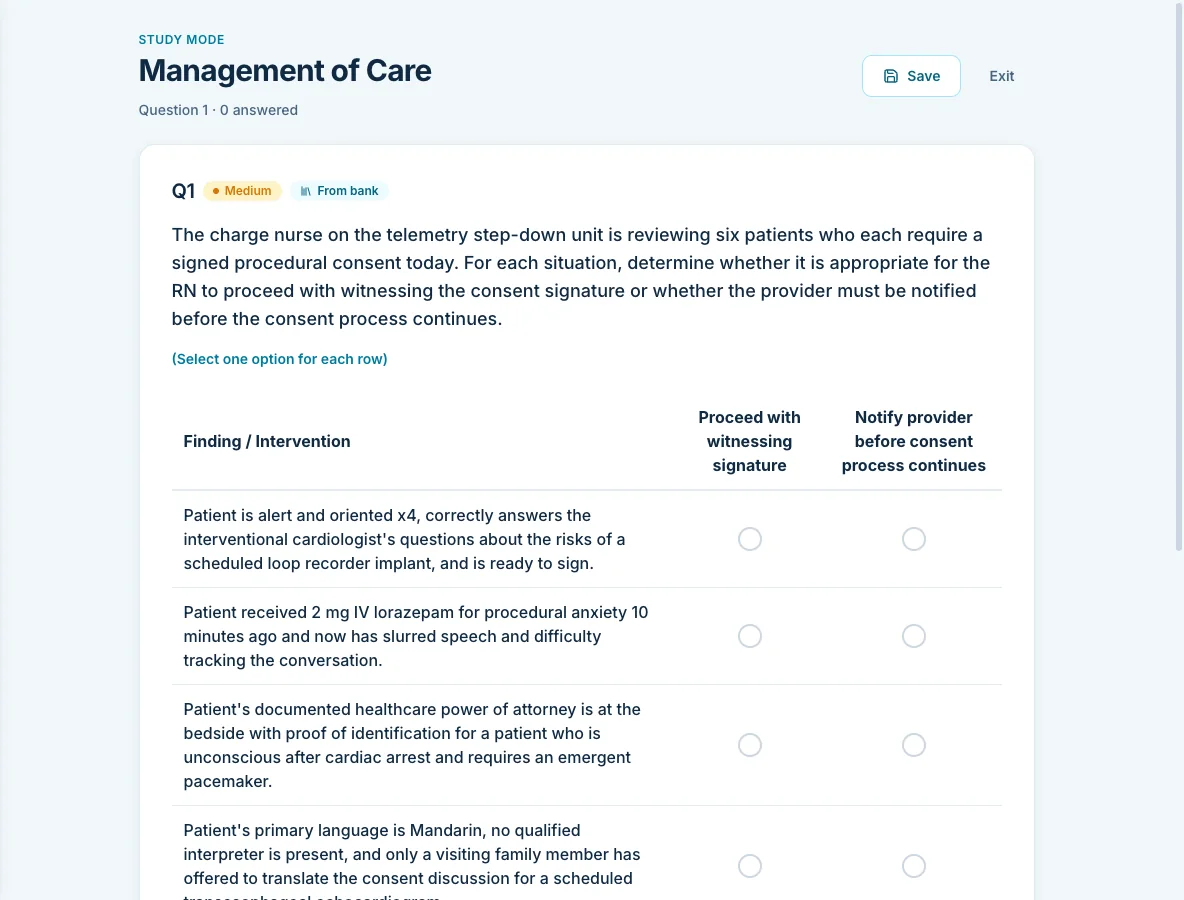
A dyad item presents a single sentence containing two drop-down menus or drag-and-drop targets. The first target represents a proposed action, finding, or condition. The second target establishes the underlying cause or clinical rationale. A triad item expands this structure across three linked components, such as a primary diagnosis, a priority action, and an expected parameter.
The core challenge lies in how the scoring algorithm evaluates these linked components. Many candidates assume that choosing one correct drop-down option grants half credit. Under rationale scoring rules, partial credit is not awarded for isolated parts. If either half of a dyad is incorrect, you earn zero points for that entire pair. When preparing cohorts, nursing faculty must emphasize that correct actions based on false reasoning demonstrate unsafe care.
Why nclex dyad and triad rationale scoring matters in 2026 (The Data)
The National Council of State Boards of Nursing (NCSBN) introduced rationale scoring to measure sound judgment. Safe bedside nursing requires more than picking a safe action by luck. A nurse must understand why an action is indicated for a specific client presentation.
In the modern exam format, candidates encounter between 85 and 150 items over a 5-hour testing window. This testing bank includes 15 unscored pretest items. Every candidate completes at least three unfolding case studies that contain six questions each. These case studies mirror real electronic health records with history, nurses' notes, vitals, labs, and orders.
Rationale items frequently appear inside these unfolding scenarios and as stand-alone items. The NCLEXIT question bank contains 4028 practice questions in the bank (Source: NCLEXIT production data). It also features 52 unfolding case-study scenarios (Source: NCLEXIT production data). Practicing these paired formats helps candidates avoid unpaired guessing. Reviewing our nclex study notes helps solidify the underlying pathophysiology needed to link actions to client conditions correctly.
Step-by-step: how to approach nclex dyad and triad rationale scoring (The Solution)
Approaching paired rationale items requires a structured process aligned with the NCSBN Clinical Judgment Measurement Model. All six cognitive skills sit in Layer 3 of this model. You can navigate linked questions systematically by following these clear steps.
Step 1: Identify the primary condition
Start by reviewing the client chart to identify acute findings. For instance, note that early signs of rising intracranial pressure include restlessness, confusion, and headache. Conversely, a widening pulse pressure is a late sign of rising intracranial pressure. Determine the core physiological problem before looking at the drop-down options.
Step 2: Connect the mechanism to the intervention
Examine the relationship stated in the prompt sentence. A dyad often takes the form: 'The nurse should administer [Intervention] because the client is experiencing [Pathophysiology]'. Confirm that your chosen intervention directly addresses the specific physiological state identified in the second blank.
Step 3: Verify the entire statement as a cohesive unit
Read the completed sentence from start to finish. Check whether both parts remain clinically true when read together. Never select an intervention that fits a different diagnosis, even if that intervention is safe in general. Pairing an accurate drug with the wrong clinical indication results in zero credit for the entire dyad.
You can refine this structured reasoning through our nclex study plan and interactive case simulations.
Common mistakes to avoid (The Warning)
The most frequent error candidates make is treating rationale items like standard select-all-that-apply questions. Standard multi-select items add a point for correct options and subtract a point for incorrect options down to zero. In contrast, rationale items use an all-or-nothing linkage for each pair.
| Scoring Model | Question Formats | Point Award Rule |
|---|---|---|
| Rationale (Dyad) | Drop-down cloze, Drag-and-drop | 1 point only if both parts are correct; 0 points if either part is wrong |
| Rationale (Triad) | Drop-down cloze, Drag-and-drop | 1 point only if all three parts are correct; 0 points if any part is wrong |
| 0/1 Scoring | Multiple choice, Bow-tie boxes | 1 point for each fully correct option or box |
| +/- Scoring | Select-all-that-apply, Highlight | +1 for correct choices, -1 for incorrect choices; item floor of zero |
Another major mistake is selecting a clinically sound intervention that does not match the paired rationale. For example, administering a diuretic is a standard treatment for fluid overload. However, if the cause blank states dehydration, the paired answer is fundamentally flawed. Candidates who rush often spot a familiar drug and overlook an incompatible rationale.
Faculty and candidates can compare different item models using our guide on nclex prep for nursing schools to ensure curriculum alignment.
Expert insight and what changes next (The Authority)
Licensing bodies in the United States and provincial regulatory colleges in Canada demand measurable clinical judgment from entry-level nurses. Evaluating whether a candidate understands the cause of an intervention protects client safety. Memorizing isolated nursing facts without grasping pathophysiology is no longer sufficient.
Modern preparation systems use targeted simulations to evaluate reasoning. Across our platform, 130 voice scenarios with a recorded discrimination index evaluate spoken decisions (Source: NCLEXIT production data). These voice scenarios maintain a 61.1 mean discrimination index across voice scenarios (Source: NCLEXIT production data). This pre-release index measures how well a scenario separates safe clinical responses from unsafe ones.
When practicing for the NCLEX-RN, focus on how Layer 3 cognitive steps connect. Recognize cues, analyze cues, and prioritize hypotheses before generating solutions. Mastering nclex dyad and triad rationale scoring ensures you receive full credit for the clinical links you make on test day.
Frequently asked questions
What happens if I get one part of a dyad question right and one part wrong?
You earn zero points for that dyad item. Rationale scoring awards credit only when both linked options in the pair are correct.
Do dyad and triad items allow partial credit?
No, dyad and triad items do not award partial credit within a linked group. Every component of the dyad or triad must be accurate to receive the point.
How does dyad scoring differ from select-all-that-apply scoring?
Select-all-that-apply items use plus-minus scoring where correct answers earn points and incorrect answers lose points. Dyads use rationale scoring where linked answers must both be correct to earn a single point.
Which question formats use rationale scoring on the NCLEX-RN?
Drop-down cloze sentences, drop-down tables, and drag-and-drop rationale items use dyad or triad scoring models.
Get new insights as they publish
One evidence-checked article at a time, plus a free-trial link. No sequence, one click unsubscribes.