NCLEX Legal Ethical Nursing Considerations: Management of Care Guide
Mastering nclex legal ethical nursing considerations requires candidates to balance regulatory law, professional boundaries, and client advocacy across varied clinical scenarios. You must understand the precise role of the registered nurse regarding informed consent, living wills, durable power of attorney, and statutory reporting obligations. Licensing bodies like the NCSBN in the United States and provincial nursing colleges in Canada evaluate these decisions under the Management of Care client needs category. Your clinical judgment must protect client rights while maintaining public safety and legal compliance.

What is nclex legal ethical nursing considerations? (The Problem)
On the NCLEX-RN exam, legal and ethical questions appear primarily within the Management of Care category. Candidates often struggle when clinical duties conflict with client choices. A nurse is not merely a caregiver. You also serve as an advocate, an educator, and a legal witness.
The test evaluates how you handle real dilemmas. These include a client who refuses life-saving care, an impaired coworker, or a family member demanding restricted health information. The exam tests strict regulatory lines. In the United States, federal rules like HIPAA govern privacy. In Canada, provincial privacy acts dictate chart access. International candidates and new graduates often find these distinctions difficult during revision.
A core challenge is separating hospital policy from statutory law. For example, a hospital policy may suggest talking a client into a procedure. However, statutory law protects client autonomy above institutional preference. You must identify which ethical principle controls each scenario. You can review foundational frameworks in our NCLEX study notes to reinforce these rules.
Why nclex legal ethical nursing considerations matters in 2026 (The Data)
Safe nursing practice begins with legal and ethical accountability. Next-Generation NCLEX items use unfolding case studies to assess how candidate actions affect real client outcomes over time. Understanding your legal scope prevents severe patient harm and license revocation.
Clinical judgment scenarios on the exam frequently include complex decisions about confidentiality and consent. NCLEXIT maintains a bank of 4028 practice questions (Source: NCLEXIT production data). Within this bank, ethical and legal dilemmas test direct candidate decision-making. Furthermore, NCLEXIT includes 130 voice scenarios with a recorded discrimination index (Source: NCLEXIT production data). These voice simulations carry a 61.1 mean discrimination index across voice scenarios (Source: NCLEXIT production data). Each scenario is tested to confirm it separates safe responses from unsafe ones.
Candidates must prepare for items where every option seems plausible. When analyzing care scenarios, you must pinpoint the exact boundary between provider duties and nurse responsibilities. You can test your ability to distinguish complex leadership concepts using our guide on NCLEX delegation and prioritization.
Step-by-step: how to approach nclex legal ethical nursing considerations (The Solution)
When resolving legal and ethical items, apply a structured decision model to select the safest answer.
Step 1: Identify the Governing Ethical Principle
Determine which ethical pillar applies to the stem. The main principles include autonomy, beneficence, nonmaleficence, justice, fidelity, and veracity. If a competent client refuses therapy, client autonomy overrides provider preference. You must support the client while confirming they understand all potential risks.
Step 2: Clarify the Role in Informed Consent
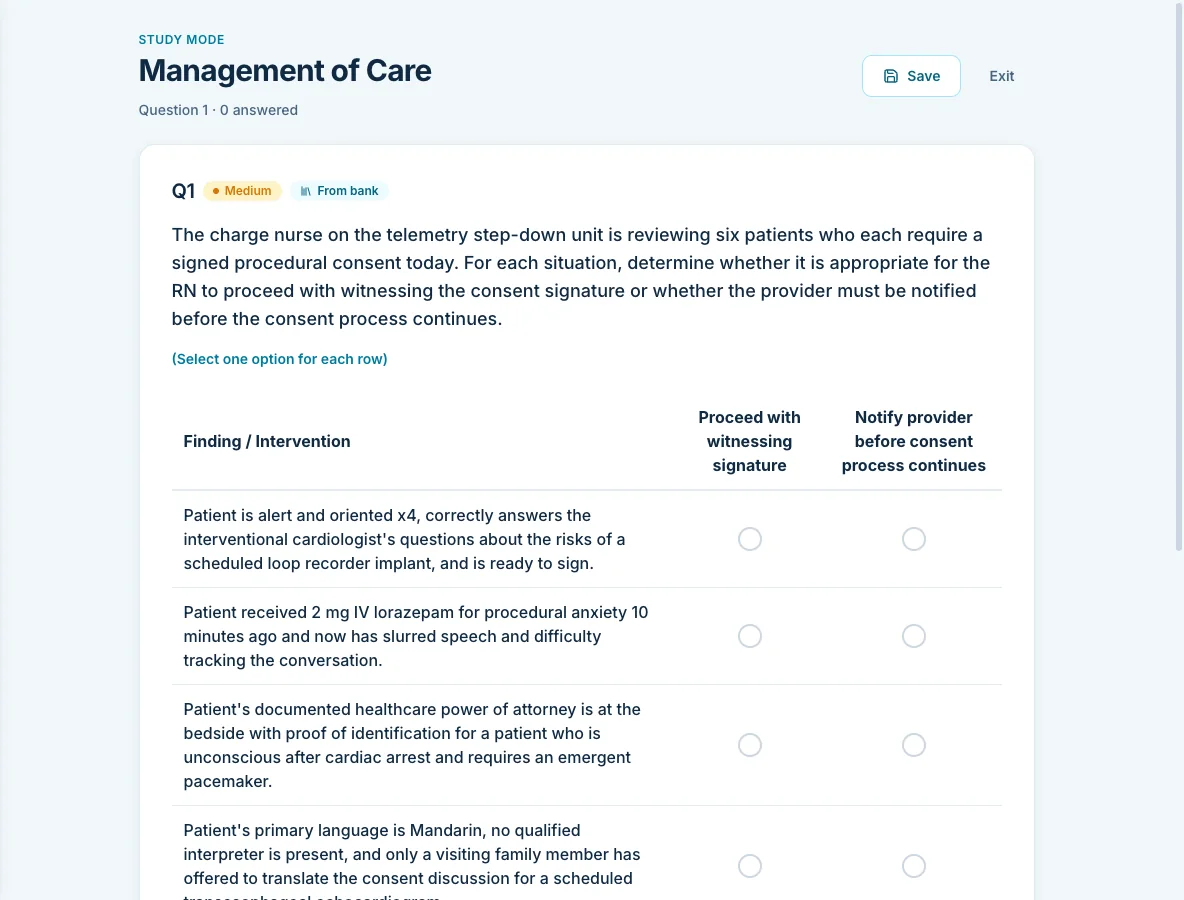
Distinguish the role of the healthcare provider from the role of the nurse. The provider performing the procedure must explain risks, benefits, and alternatives. The nurse only acts as a consent witness. You verify that the client is competent, voluntary, and informed. If the client expresses confusion, you must notify the provider immediately rather than explaining the surgical procedure yourself.
Step 3: Verify Advance Directives and Capacity
Review the client record for a living will or a durable power of attorney for healthcare. A health care proxy only makes decisions when the client loses decision-making capacity. As long as a client remains oriented and capable, their verbal choices supersede previous documents or family wishes. Canadian candidates can review jurisdictional differences in advance planning using our guide on the NCLEX for Canadian candidates.
Step 4: Execute Mandatory Reporting Obligations
Identify situations that require mandatory reporting by law. Nurses must report suspected child abuse, elder abuse, intimate partner violence where mandated by local statute, and certain communicable diseases. You do not need absolute proof before making a report. You only need a reasonable suspicion based on clinical cues. Never conduct an independent investigation before notifying protective authorities.
Step 5: Address Colleague Impairment Immediately
If you observe an impaired colleague or suspect substance diversion, protect client safety first. Report the concern immediately so the colleague can be relieved of client care. Next, report the observation to the charge nurse or nurse manager. Do not confront the colleague alone or ignore the signs.
Common mistakes to avoid (The Warning)
Many candidates lose points on legal questions due to subtle misconceptions. Avoiding these common traps will keep your answers safe and legally sound.
- Providing procedure details during consent: The nurse must never explain surgical risks to obtain consent. Doing so breaches professional scope. Always hold the consent form and call the primary provider back to the bedside.
- Allowing family to override competent clients: Family members cannot change care plans if the client is legally competent. Even a designated proxy has no authority while the client retains decision-making capacity.
- Failing to identify unauthorized chart access: Looking at records for clients not assigned to you violates privacy laws. This applies even if the client is a close friend, family member, or colleague.
- Delaying reports of suspected abuse: Waiting for definitive evidence or physical proof before reporting suspected abuse is a dangerous error. The law requires reporting based on reasonable suspicion alone.
- Ignoring false imprisonment risks: Applying physical or chemical restraints without an active order or outside emergency protocols constitutes false imprisonment. Always attempt de-escalation and least restrictive measures first.
Expert insight and what changes next (The Authority)
Modern nursing practice requires high-level judgment around complex technology, telehealth, and client data integrity. In both the United States and Canada, regulatory bodies demand strict compliance with professional practice acts. Future test items increasingly integrate clinical judgment steps into legal scenarios.
When solving NGN unfolding case studies, expect legal cues to appear inside electronic health records. You may see advance directive documents, provider progress notes, and emergency department intake logs in one case. NCLEXIT provides 52 unfolding case-study scenarios (Source: NCLEXIT production data) that simulate real patient charts across these domains.
Mastering nclex legal ethical nursing considerations protects your future license. Practice applying the NCSBN Clinical Judgment Measurement Model to every ethical dilemma you encounter. Recognize the cue, evaluate the legal constraint, prioritize safety, and take decisive action.
Frequently asked questions
What is the nurse's exact responsibility for informed consent on the NCLEX-RN?
The nurse witnesses the client signature and verifies that the client is competent and voluntary. The nurse must never provide the initial explanation of surgical risks or procedure details.
When does a durable power of attorney take effect?
A durable power of attorney for healthcare only activates when the client loses the capacity to make their own medical decisions. While the client is competent, their immediate choices govern care.
Do nurses need proof before filing a mandatory abuse report?
No, nurses do not need physical proof or definitive evidence before reporting suspected abuse. A reasonable clinical suspicion is the legal standard required to notify authorities.
What should a nurse do when observing an impaired colleague on duty?
The nurse must protect client safety by immediately reporting the observation to the charge nurse or supervisor, who removes the colleague from client care.
Get new insights as they publish
One evidence-checked article at a time, plus a free-trial link. No sequence, one click unsubscribes.