NCLEX Matrix Grid Question Strategy for RN Candidates
An effective nclex matrix grid question strategy treats every row as an independent true-or-false decision based on clinical evidence. The National Council of State Boards of Nursing (NCSBN) uses matrix grids to measure complex judgment across multiple client findings. Candidates must determine whether a grid uses single-response radio buttons or multi-response checkboxes. Understanding the underlying +/- scoring rule protects your overall score. You should only select an option when documented chart data directly supports that choice.

What is nclex matrix grid question strategy? (The Problem)
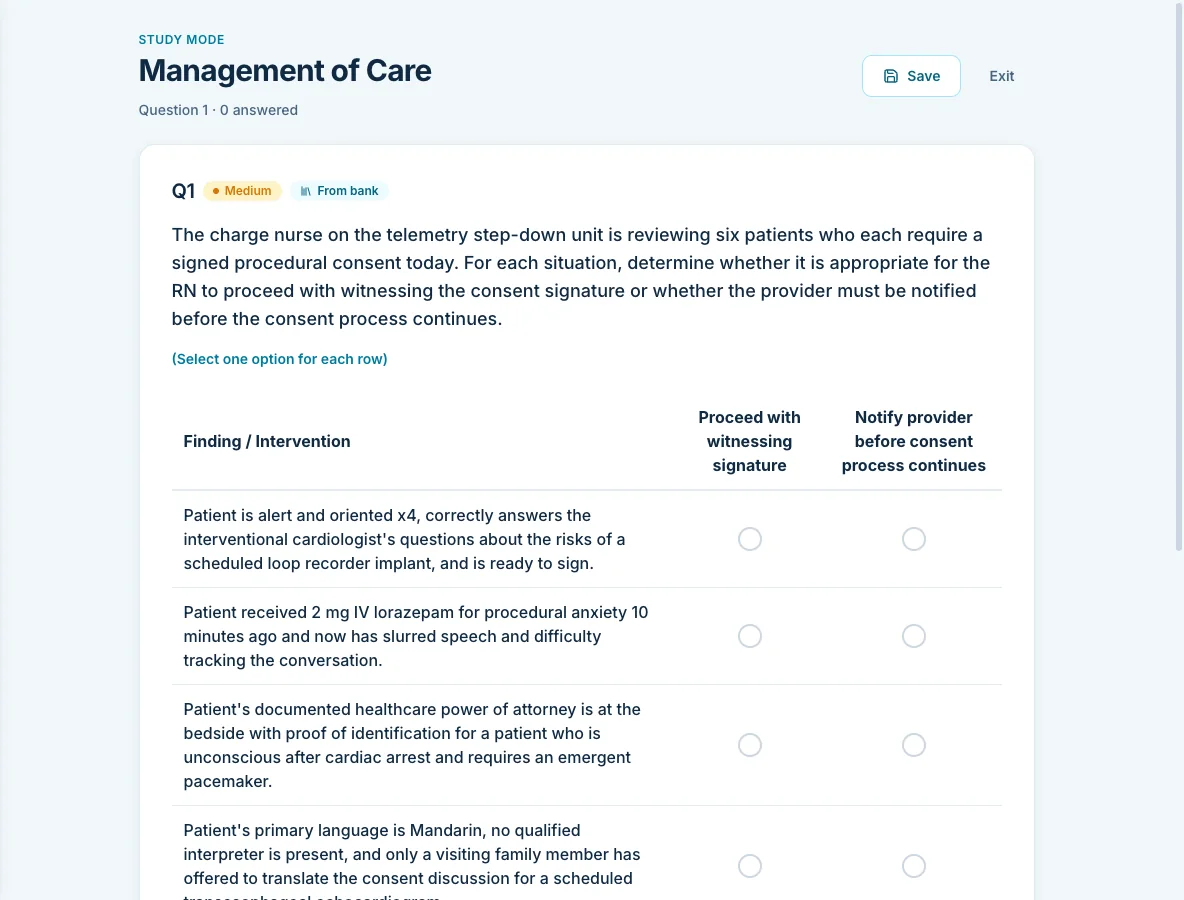
Matrix grid questions present clinical data in a spreadsheet layout. You will see several rows of client findings, interventions, or symptoms paired with two or more category columns. Many candidates find these tables intimidating because a single grid contains multiple decision points. Without a clear nclex matrix grid question strategy, you risk losing points on rows you understand well.
These items appear in standalone questions and within unfolding case studies. The table format requires you to evaluate client data against specific nursing concepts. You may need to categorize lab values as expected or unexpected. Other grids ask you to evaluate if an intervention is indicated, contraindicated, or non-essential. Each row tests your ability to recognize and analyze clinical cues.
The primary hurdle is cognitive overload. When you view five rows and three columns simultaneously, the data feels overwhelming. Candidates often try to balance answers across columns instead of evaluating the client chart. Success requires isolating each row and applying structured clinical deduction to the specific client scenario.
Why nclex matrix grid question strategy matters in 2026 (The Data)
Next-Generation NCLEX items use polytomous scoring models to assess partial knowledge. Matrix questions are scored using specific mathematical rules defined by the NCSBN. Matrix Multiple Choice items use radio buttons and award one point per correct row. Matrix Multiple Response items use checkboxes and follow the plus-minus scoring model. In this model, correct selections earn one point while incorrect selections subtract one point.
Understanding this mathematical structure changes how you should approach each row. Under plus-minus rules, the total item score cannot drop below zero. However, an incorrect selection cancels out a point earned on another valid row. A random guess actively damages your score on multi-response grids. Knowing when to withhold a selection is just as critical as identifying correct findings.
NCLEXIT maintains 4028 practice questions in the bank (Source: NCLEXIT production data). The platform also features 52 unfolding case-study scenarios (Source: NCLEXIT production data). Practicing with calibrated item formats helps candidates build stamina for complex grid structures. Mastering grid mechanics ensures you retain the maximum possible points across every case study.
Step-by-step: how to approach nclex matrix grid question strategy (The Solution)
Follow this systematic four-step process to manage every matrix grid item on the exam. Candidates can refine this workflow by following a structured nclex study plan.
Step 1: Identify the Grid Type and Scoring Rule
Examine the selection controls in the table. Circular radio buttons indicate Matrix Multiple Choice. You must select exactly one column per row. Square checkboxes indicate Matrix Multiple Response. Checkbox grids allow multiple selections per row and use partial credit scoring with point deductions for errors.
Step 2: Review Client Chart Tabs for Supporting Data
Open the nurses' notes, vital signs, and laboratory reports. Identify the primary diagnosis, baseline parameters, and acute changes. Do not read the matrix rows until you understand the timeline. You must ground your reasoning in documented objective findings rather than assumptions.
Step 3: Apply Row-by-Row Clinical Deduction
Treat each horizontal row as an independent clinical statement. Ask yourself: does the chart support this specific finding for this client right now? If a row describes an intervention, evaluate whether it is safe and appropriate. When reviewing delegation or care assignments, apply clear principles from nclex delegation prioritization guidelines.
Step 4: Audit for Unsubstantiated Selections
Review your selected boxes before submitting the response. On checkbox items, verify that every checkmark has direct backing in the client record. If you are uncertain about an extra option, leave it unselected so it does not cancel a point on that item.
Common mistakes to avoid (The Warning)
The most common error is selecting options based on generalized textbook facts rather than the specific client chart. An intervention might be standard for heart failure, but it could be unsafe if the client has acute kidney injury. Always verify that a medication or action matches the current assessment data.
Another major mistake is trying to create visual symmetry across the grid. Candidates often assume that every column must contain at least one selection. NCSBN matrix items are not designed with forced symmetry. One column may contain four selections while an adjacent column receives none. Avoid forcing an answer simply to fill an empty column.
Over-selecting on Matrix Multiple Response items also causes severe score loss. Candidates who treat checkboxes like standard multiple-choice questions often select borderline answers. In plus-minus scoring, an extra incorrect click eliminates a hard-earned point. You can analyze item structures further through our guide on nclex question quality to understand how valid distractors are authored.
Expert insight and what changes next (The Authority)
Modern nursing licensure focuses on direct measurement of clinical judgment. Both the NCSBN and provincial Canadian nursing regulators emphasize safe decision-making over pure memorization. Matrix items reflect real electronic health records where nurses cross-reference multi-tab charts before administering care.
Adaptive learning platforms now evaluate how candidates reach clinical decisions. NCLEXIT features 130 voice scenarios with a recorded discrimination index (Source: NCLEXIT production data). These voice simulations carry a 61.1 mean discrimination index across voice scenarios (Source: NCLEXIT production data). This metric shows each voice scenario separates safe clinical practice from unsafe actions before reaching candidates.
As you prepare, focus on the six core steps of the clinical judgment model. Practice identifying subtle cue changes across sequential chart entries. When you approach every matrix grid systematically, you protect your score and develop sound clinical instincts for daily nursing practice.
Frequently asked questions
What is the difference between Matrix Multiple Choice and Matrix Multiple Response?
Matrix Multiple Choice uses radio buttons and requires exactly one selection per row. Matrix Multiple Response uses checkboxes, allowing candidates to select one or more options per row or column.
How does scoring work on NCLEX matrix questions?
Single-response matrix rows award one point for each correct choice. Multiple-response matrix items use plus-minus scoring, where correct answers earn one point and incorrect choices deduct one point, with a minimum item score of zero.
Can my score on an NCLEX matrix grid drop below zero?
No, the total score for any individual item cannot drop below zero. However, incorrect selections will subtract points earned from correct selections within that same question.
Should I guess on NCLEX matrix checkbox items?
You should not make random guesses on checkbox matrix items due to point deductions. Only select an option when the documented client chart directly supports that intervention or finding.
Get new insights as they publish
One evidence-checked article at a time, plus a free-trial link. No sequence, one click unsubscribes.