NCLEX Select All That Apply Scoring Rules and Scoring Model

What is NCLEX Select All That Apply Scoring Rules? (The Problem)
For years, multiple-response questions caused severe anxiety for candidates. Under the older format, select-all-that-apply items were scored as all-or-nothing. If a question had five correct options and you selected four, you received zero points. Candidates faced harsh penalties for small omissions.
The Next-Generation NCLEX changed this framework. The testing model now uses partial-credit scoring across several item formats. Specifically, multiple-response items follow standard nclex select all that apply scoring rules based on an additive and deductive formula. When you review your choices, each correct selection adds a positive point.
However, selecting an incorrect option introduces an incorrect option penalty. The algorithm subtracts one point for that error. The final score equals total correct selections minus incorrect selections. The overall item score never falls below zero. This protection is called the item floor of zero. You can review how this shapes your preparation in our nclex study plan guide.
Partial credit removes the harsh penalty of older formats. You now earn points for accurate clinical decisions. At the same time, the scoring system discourages random guessing. You must evaluate every option on its clinical merit before making a selection.
Why NCLEX Select All That Apply Scoring Rules Matter in 2026 (The Data)
Scoring accuracy affects your final item evaluations during the examination. The NCLEX-RN uses a variable-length adaptive engine. The exam ranges from 85 to 150 items. In this structure, every point helps establish your ability estimate above the passing line.
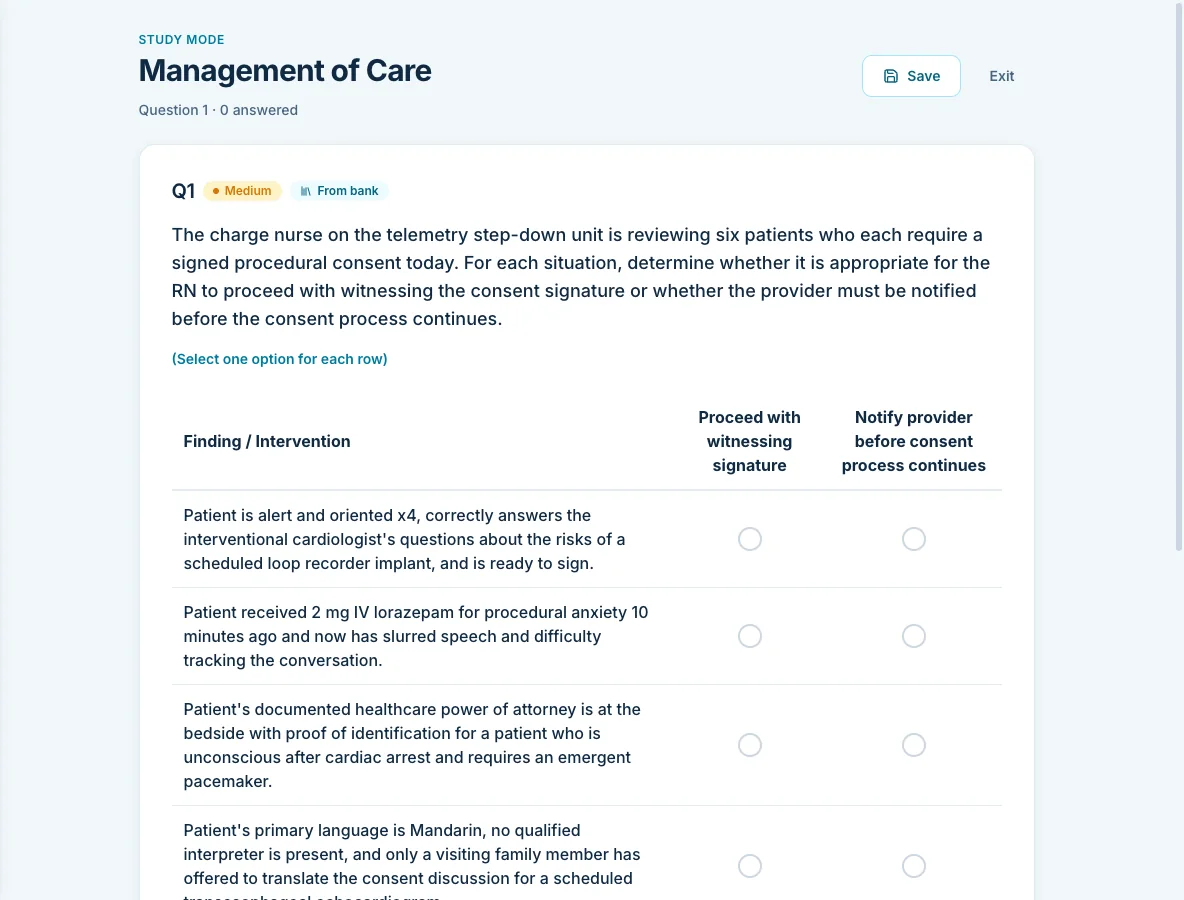
Candidates face multiple question types across the examination. Multiple-choice questions use standard 0/1 scoring. Drag-and-drop rationale items require both linked parts to be correct. In contrast, select-all-that-apply, matrix multiple-response, and highlight items use the plus-minus method. Practicing with our bank of 4028 practice questions helps you apply these rules consistently (Source: NCLEXIT production data).
Consider a clinical scenario involving neurological assessment. Suppose a client shows early signs of rising intracranial pressure. Early signs include restlessness, confusion, and headache. In contrast, a widening pulse pressure is a late sign of rising intracranial pressure. If an item asks for early indicators and you select two early signs plus one late sign, you earn two points and lose one point. Your net result is one point. Knowing these nclex select all that apply scoring rules prevents reckless over-selection.
Cushing's triad also includes bradycardia and irregular respirations. These are late signs as well. Confusing early and late indicators leads to point deductions under plus-minus scoring. Accurate clinical knowledge protects your score across every question.
Step-by-Step: How to Approach NCLEX Select All That Apply Scoring Rules (The Solution)
You can optimize your score on multiple-response items by following a structured decision process. Working through our 52 unfolding case-study scenarios will help you practice these steps systematically (Source: NCLEXIT production data).
Step 1: Treat Each Option as an Independent True or False
Read the item stem carefully. Evaluate every option on its own merits. Ask whether the intervention is safe, indicated, and supported by clinical evidence.
Step 2: Select Only Confirmed Correct Answers
Choose an option only when you are confident in its clinical rationale. Each accurate selection awards one positive mark. Build your score deliberately by verifying each choice.
Step 3: Leave Uncertain Distractors Unchecked
Because incorrect selections deduct points, guessing carries a direct mathematical penalty. If you are unsure about an option, leaving it blank avoids an unnecessary point deduction. You protect points already earned.
Step 4: Check for the Item Floor Protection
Remember that negative totals do not carry over to subsequent questions. If you pick one correct option and two incorrect ones, the calculation yields minus one. The zero-point floor resets the item score to zero.
You can refine these clinical decisions alongside an ai nclex tutor that monitors your judgment in real time.
Common Mistakes to Avoid (The Warning)
A frequent error is reckless over-selection. Candidates trained on older testing advice often select extra options. They hope to catch missed answers. Under plus-minus rules, this behavior erases valid points.
Another common mistake is confusing scoring methods across item types. Multiple-choice and select-N questions use strict 0/1 scoring. Bow-tie items score each of the five boxes independently as 0/1. Drop-down cloze items also use 0/1 scoring. Matrix multiple-choice items with one answer per row use 0/1 scoring too. Do not apply plus-minus deductions to single-response formats. Learn more about managing question styles in our nclex question quality overview.
Candidates also misapply clinical priorities under pressure. For instance, if a staff nurse suspects an impaired colleague at work, the nurse reports immediately to the charge nurse or supervisor. Choosing informal confrontation instead loses points on regulatory safety items. Avoid choosing unsafe actions that trigger a negative scoring deduction. Selecting safe, verified interventions protects your exam performance.
Expert Insight and What Changes Next (The Authority)
The regulatory boards designed partial credit to mirror clinical reality. In professional nursing practice, completing three correct safety steps provides value. Making an error introduces risk. The scoring model measures this balance directly.
The NCSBN Clinical Judgment Measurement Model has four layers. Its six cognitive skills all sit in Layer 3; call them steps 1 to 6. These steps are recognize cues, analyze cues, prioritize hypotheses, generate solutions, take action, and evaluate outcomes. Multiple-response items test your ability to execute these steps accurately.
Standardized testing across the United States and Canada relies on these principles. Regulators like the NCSBN and Canadian provincial colleges focus on public safety. Candidates must master clinical judgment rather than relying on elimination tricks. Voice simulation tools provide insight into decision-making. NCLEXIT maintains 130 voice scenarios with a recorded discrimination index, averaging a 61.1 mean discrimination index across voice scenarios to separate safe from unsafe responses during pre-release testing (Source: NCLEXIT production data). Practicing under exact scoring constraints builds sound testing habits.
Frequently asked questions
Can you get negative total points on a SATA item?
No, you cannot receive a negative total score. Every multiple-response item has a scoring floor of zero points.
Do incorrect answers subtract points on regular multiple-choice questions?
No, multiple-choice questions use standard 0/1 scoring without deductions. Incorrect options simply earn zero points.
How does rationale scoring differ from SATA scoring?
Rationale items score linked causes and effects together. You receive credit only when both parts of the dyad or triad are correct.
Should I guess on select-all-that-apply questions if I am uncertain?
No, you should avoid blind guessing on multiple-response items. An incorrect selection deducts a point from your correct answers.
Get new insights as they publish
One evidence-checked article at a time, plus a free-trial link. No sequence, one click unsubscribes.