NCLEX test day what to expect: an hour-by-hour walk-through
NCLEX test day what to expect comes down to a fixed routine: arrive early, show matching ID, give a palm vein scan, sign the Candidate Statement, then test. Arrive at least 30 minutes before your appointment (Source: NCSBN, nclex.com Exam Day and Acceptable ID pages). The exam runs up to 5 hours, with 85 to 150 items and optional breaks (Source: NCSBN). It ends by one of three stopping rules. This guide walks you through each step.
What is NCLEX test day, and what should you expect?
Test day is a controlled, step-by-step process. Most candidates feel nervous because they do not know the steps. Knowing the order removes much of that worry.
The exam takes place at a secure test center. Every candidate follows the same check-in routine. The rules protect the exam and every candidate who sits it.
Since April 2023, the NCLEX-RN has 85 minimum and 150 maximum items (Source: NCSBN). Fifteen are unscored pretest items. You will not know which ones, so treat every item as if it counts.
The clock allows 5 hours in total (Source: NCSBN). That includes optional breaks at about 2 hours and 3.5 hours. You will also see three unfolding case studies with six items each. These test clinical judgment as the client's picture changes.
Two regulators matter here. In the United States, NCSBN runs the exam. In Canada, your provincial college handles registration and eligibility. Check your own regulator before you book.
Here is the short version of the day:
- Arrive early and put your belongings away.
- Show your ID and complete check-in.
- Sign the Candidate Statement.
- Test, with optional breaks.
- The exam stops by rule, not by your choice.
Why knowing what to expect on NCLEX test day matters
Small errors on test day can end your attempt before the first item. An ID problem is the clearest example. You can be fully prepared and still be sent home.
Admission needs one valid, non-expired, physical government-issued ID. It must show a photo and a signature. Your first and last names must match your registration exactly. A name mismatch means you are turned away and must pay a new fee (Source: NCSBN, nclex.com Exam Day and Acceptable ID pages).
Timing matters too. You are expected to arrive at least 30 minutes early (Source: NCSBN, nclex.com Exam Day and Acceptable ID pages). That buffer covers parking and a calm start.
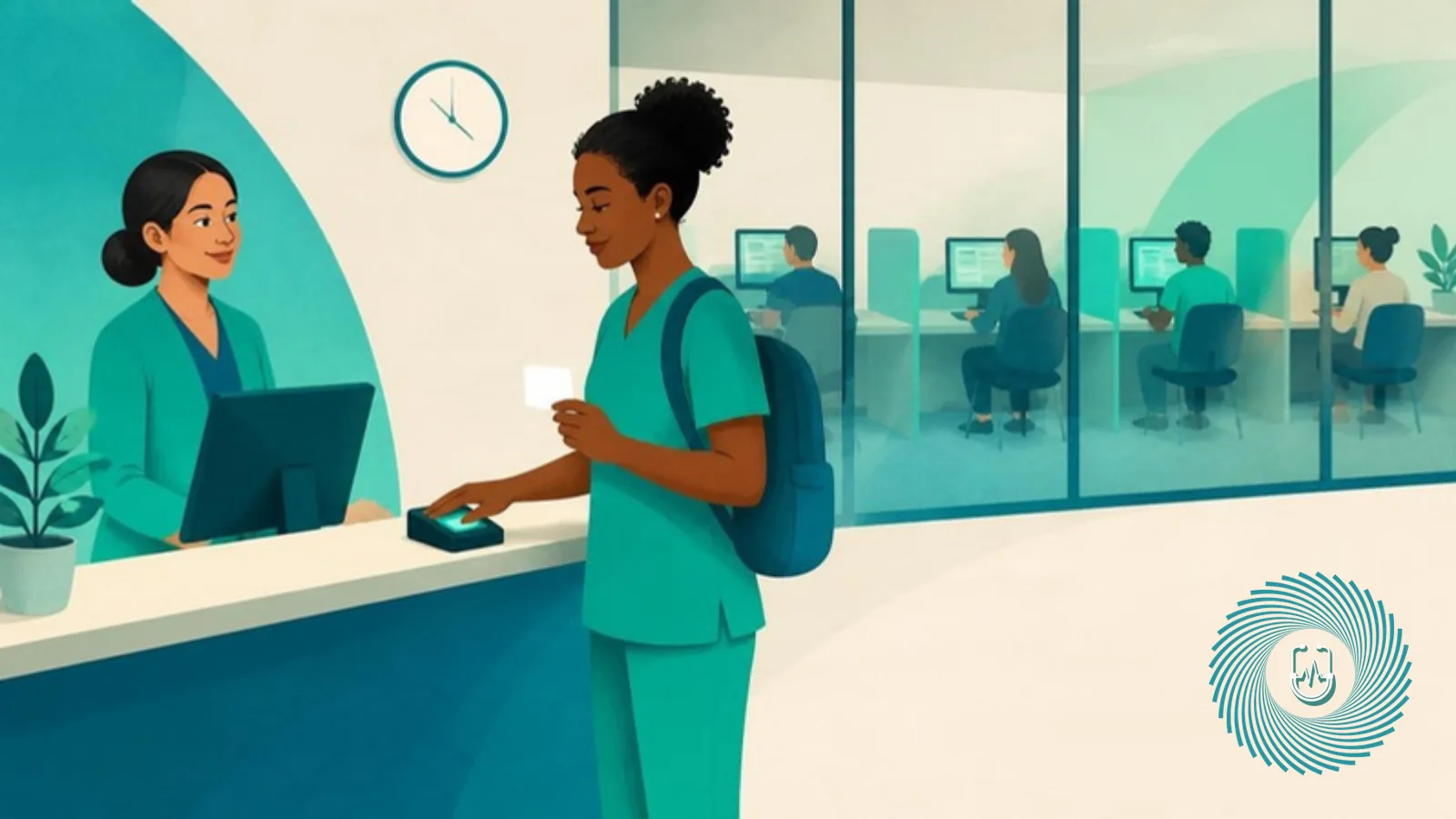
Staff capture a signature, a photograph, and a palm vein scan at check-in. The scan repeats before and after breaks (Source: NCSBN, nclex.com Exam Day and Acceptable ID pages). Audio and video also monitor you.
Knowing this means a repeat scan or a camera will not catch you off guard.
Step by step: how to approach test day
Work through the day in order. Each step is something you can prepare for ahead of time.
Step 1: The night before
Lay out your ID and confirmation. Check that the name on your ID matches your registration letter by letter. Plan your route. Go to bed at a normal hour.
Step 2: Arrive at least 30 minutes early
Aim to be at the center at least 30 minutes before your appointment (Source: NCSBN, nclex.com Exam Day and Acceptable ID pages). Add extra time for traffic.
Step 3: Present your ID
Hand over one valid, non-expired, physical government-issued ID. It needs a photo and a signature. A photo on your phone will not work.
Step 4: Complete check-in
Staff capture your signature, a photograph, and a palm vein scan. Hold your hand still and follow the prompts. You repeat the scan before and after breaks.
Step 5: Read and sign the Candidate Statement
You read the Candidate Statement and sign it electronically. It covers the rules of the exam. Read it. Do not skim it.
Step 6: Start testing and pace yourself
Work one item at a time. Read the full stem before the options. Do not guess your exam length from how hard the items feel. Many candidates feel unsure all the way through. That is normal.
Step 7: Use your breaks on purpose
Optional breaks come at about 2 hours and 3.5 hours. A break can help you reset. Watch the clock, since break time counts against your 5 hours.
Step 8: Know what ends the exam
Three rules can end the exam: 95% confidence, maximum length, or running out of time (Source: NCSBN, nclex.com). If you run out of time before 85 items, you do not pass. If time runs out after 85, you pass only if your ability estimate stayed above the standard for each of the last 60 items. Stopping at 85 does not by itself mean pass or fail.
To rehearse this routine, build timed practice into your NCLEX study plan. Full mock exams of 85 to 150 questions on a 5-hour clock show you how pacing feels. A mock interview can help later, for your first nursing post.
Common mistakes to avoid on test day
Most test-day problems are avoidable. They come from rushed planning, not weak knowledge.
Bringing the wrong ID
An expired card, a photocopy, or a name mismatch can end your day at the door. You are turned away and pay a new fee (Source: NCSBN, nclex.com Exam Day and Acceptable ID pages). Check this a week ahead, not the night before.
Arriving late
Cutting your arrival too close adds stress and risks problems at check-in. Plan to arrive at least 30 minutes early.
Misreading what the stopping point means
Many candidates think a short exam means they passed. Others think a long one means they failed. Neither is true. Do not judge your result by the item count.
Ignoring the clock
Running out of time before 85 items means you do not pass. Do not spend several minutes on one item. Make your best choice and move on.
Skipping breaks or ignoring the scan
Pushing through without a break can drain focus. If you take one, expect the repeat palm vein scan before and after.
Trying to beat the system
Audio and video monitor you the whole time. Do not try to look at notes, devices, or other people. Breaking exam rules can cost you the attempt.
Practicing only content
Content review matters, but so does stamina. Practice under timed conditions so the 5-hour length does not surprise you. Good study notes help, but they do not replace timed mock exams.
Expert insight and what to prepare next
Nurse educators often say the same thing. The exam tests judgment, and judgment suffers when you are rattled. A steady routine protects your thinking.
The NCSBN Clinical Judgment Measurement Model has four layers. Its six cognitive skills all sit in Layer 3. We call them steps 1 to 6: recognize cues, analyze cues, prioritize hypotheses, generate solutions, take action, and evaluate outcomes.
Scoring varies by item type. Multiple choice is scored 0 or 1. Select-all-that-apply items use plus and minus scoring with a floor of zero. Rationale items give credit only when the linked parts are right together.
The Candidate Performance Report goes only to candidates who fail. It rates each client-need area as above, near, or below the passing standard. Use it to guide any retake plan.
On the NCLEXIT side, a diagnostic exam calibrates you, and adaptive sessions follow. The bank holds 4028 practice questions and 52 unfolding case-study scenarios (Source: NCLEXIT production data). Full mock exams use the official category weightings and a 5-hour clock. Our guide to NCLEX for Canadian candidates covers the provincial steps.
Plans start with a free trial, and no card is required. Use that time to run one full mock exam, so NCLEX test day what to expect feels familiar. Then spend your final week on rest, documents, and a calm route to the center.
Frequently asked questions
How early should I arrive for the NCLEX-RN?
Arrive at least 30 minutes before your appointment (Source: NCSBN, nclex.com Exam Day and Acceptable ID pages). Add time for traffic and parking so you start calm.
What ID do I need on NCLEX test day?
You need one valid, non-expired, physical government-issued ID with a photo and signature. Your first and last names must match your registration exactly (Source: NCSBN, nclex.com Exam Day and Acceptable ID pages).
What is the palm vein scan for?
It confirms your identity at the test center. Staff take it at check-in and repeat it before and after breaks (Source: NCSBN, nclex.com Exam Day and Acceptable ID pages).
How long is the NCLEX-RN and when are breaks?
You have 5 hours, including optional breaks at about 2 and 3.5 hours. The exam has 85 to 150 items, and 15 are unscored pretest items (Source: NCSBN).
What ends the NCLEX-RN?
Three rules can end it: 95% confidence, maximum length, or running out of time (Source: NCSBN, nclex.com). Stopping at 85 items does not by itself mean pass or fail.
Am I watched during the exam?
Yes. You sign the Candidate Statement, and audio and video monitor you throughout (Source: NCSBN, nclex.com Exam Day and Acceptable ID pages).
Get new insights as they publish
One evidence-checked article at a time, plus a free-trial link. No sequence, one click unsubscribes.