New Grad Nurse Residency Interview Questions: What Panels Ask and What They Test
New grad nurse residency interview questions test your clinical judgment, safety habits, teamwork, and willingness to learn, not your years of experience. Panels know you are new. They want to hear how you think through a client problem, how you speak up, and how you take feedback. Strong answers use a real moment from a clinical placement. State the cue you noticed, name your action, and end with what you learned.

What are new grad nurse residency interview questions?
A residency program hires new graduates and pairs them with preceptors for a structured first year. The interview decides who gets a seat. You have little paid experience, so the panel cannot judge you on a work record. The new grad nurse residency interview questions shift to how you think and behave.
Most questions fall into four groups:
- Motivation: why nursing, why this unit, why this hospital.
- Behavioral: tell me about a time you made an error, handled conflict, or advocated for a client.
- Clinical judgment: what would you do if a client's condition changed?
- Growth: how do you take feedback, and what are your weak spots?
Each group tests something specific. Motivation questions test fit and retention. Behavioral questions test professional accountability. Judgment questions test whether you notice cues and act in a safe order. Growth questions test coachability.
The problem for most candidates is not a lack of stories. It is that they have never said those stories out loud. Answers in your head sound fine. Spoken answers wander, run long, and bury the point. Your practice has to be spoken.
Why these interview questions matter in 2026
Many new graduates now pass through a residency before working on their own. These programs invest months of preceptor time in each hire. That cost is why panels screen hard for safety and coachability.
You also face two gates in close order. You must pass the NCLEX-RN, and you must win the job. The exam rewards clinical judgment, and so does the interview. The NCLEX-RN has a minimum of 85 and a maximum of 150 items (Source: NCSBN). Interviewers look for the same thinking, only spoken.
The NCSBN model breaks judgment into six steps: recognize cues, analyze cues, prioritize hypotheses, generate solutions, take action, and evaluate outcomes. A strong spoken answer walks through these steps in plain words. A weak one jumps straight to an action with no reasoning.
Here is how the question types map to what the panel is scoring:
| Question type | What it tests |
|---|---|
| Tell me about an error | Honesty and reporting habits |
| Client condition changes | Cue recognition and priorities |
| Conflict with a peer | Communication and escalation |
| Why this unit | Fit and retention |
Both US and Canadian programs ask these. Canadian employers also expect you to know your provincial college's standards. US employers may refer to state boards and NCSBN. Name the right regulator when it comes up.
Step by step: how to approach these questions
Step 1: Build a story bank from your placements
List six real moments from clinical rotations. Include a changing client, a mistake or near miss, and a hard conversation. Add a time you asked for help, a teamwork win, and a moment you taught someone. Write two lines on each.
Step 2: Use a spoken structure
Use Situation, Action, Result, Lesson. Keep it to about two minutes. Open with the cue you noticed, not with background. Panels lose interest in long setup.
Step 3: Show your clinical judgment out loud
For a what-would-you-do question, say what you notice and what it could mean. Then say what matters most and what you do first. A client with a new headache and restlessness may be showing early signs of rising intracranial pressure. A widening pulse pressure is a late sign. Name the early cue, then say you would reassess and notify the provider.
Step 4: Answer the error question honestly
Pick a real near miss. State what happened and that you reported it right away. Say what the team changed and what you now do differently. Do not blame others or claim you have no weaknesses.
Step 5: Say your escalation path
Panels listen for who you tell. Suppose you suspect an impaired colleague. You report immediately to the charge nurse or supervisor. That one sentence signals safe practice.
Step 6: Rehearse aloud, then get scored
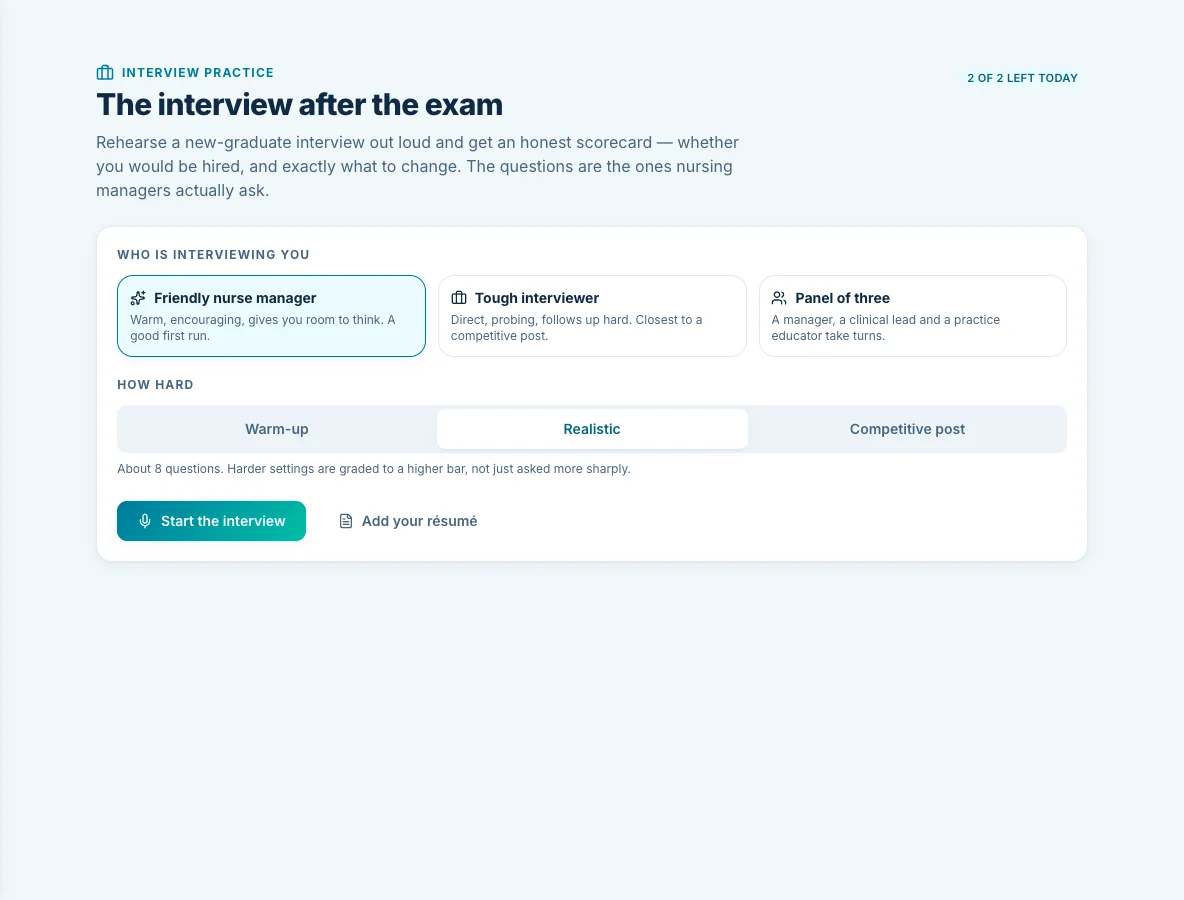
Record yourself or practice with a partner. The NCLEXIT mock interview guide explains how a spoken new-graduate interview is graded on a hiring rubric. Use it to rehearse your answers to new grad nurse residency interview questions before the real panel.
Common mistakes to avoid
Most weak answers fail in predictable ways. Fix these before you walk in.
- Vague stories. Saying "I communicate well" proves nothing. Give one specific moment with a client, a cue, and an action.
- Hiding the error. A candidate who says they have never made a mistake looks unsafe or unreflective. Panels trust honesty about a near miss far more.
- Jumping to the action. If you skip the cues and priorities, you sound like you guess. Show the reasoning first.
- Blaming the team. Complaining about a preceptor or a prior unit signals a poor fit for coaching.
- Skipping escalation. Answers that handle every problem alone are a red flag. New graduates are expected to call for help early.
- Running too long. Five-minute answers lose the panel. Aim for about two minutes and stop.
- Generic motivation. "I love helping people" fits every candidate. Name the unit, the population, and one reason this program suits you.
Another quiet mistake is treating the interview as separate from exam prep. The same habit of prioritizing, such as airway before comfort, shows up in both. If delegation questions worry you, the delegation and prioritization guide gives you a framework you can speak from.
Finally, do not memorize scripts word for word. Panels can hear it. Learn the story beats and let the words change each time.
Expert insight and what changes next
The best interview answers sound like a calm colleague thinking aloud. They are short, specific, and safe. They show that you notice, prioritize, act, and check the result. That is the same chain the NCSBN model describes for clinical judgment.
Spoken practice is the gap for many candidates. NCLEXIT offers an Interview Room where you speak a mock interview for a new-graduate RN post. You are graded on a hiring rubric. A career counsellor chat works from your own résumé, so your stories come from your real placements. You can also rehearse bedside conversations in voice clinical simulations. There are 130 voice scenarios, each with a recorded discrimination index (Source: NCLEXIT production data). That index describes how well a scenario separates safe responses from unsafe ones in pre-release testing. It says nothing about interview outcomes.
Looking ahead, expect more programs to use structured, rubric-based interviews and situational judgment prompts. That favors candidates who can explain their reasoning in plain words. Build that skill now, alongside your NCLEX-RN study. Treat new grad nurse residency interview questions as a skill you can rehearse, not a surprise.
If you want a wider view of how prep tools handle spoken and written practice, see the NCLEX prep comparison. Whatever you use, practice aloud, ask for feedback, and keep your stories honest. Honest stories told clearly are what panels remember.
Frequently asked questions
What is the most common new grad nurse residency interview question?
"Tell me about a time you made a mistake" and "Why this unit?" appear often. Prepare a real near miss and a specific reason tied to the unit's client population.
How long should my answers be?
Aim for about two minutes per answer. Lead with the situation, state your action, give the result, and finish with one lesson learned.
Can I use stories from nursing school clinicals?
Yes. Panels expect new graduates to draw on clinical placements, simulation labs, and prior work. Pick moments where you noticed a cue and acted safely.
What should I do if I do not know the answer to a clinical question?
Say so calmly, then describe how you would find out. Name who you would ask, such as your preceptor or charge nurse. That shows safe, coachable practice.
How do I practice speaking my answers?
Record yourself or use a spoken mock interview graded on a hiring rubric. Hearing your answers back shows where you ramble or skip the reasoning.
Get new insights as they publish
One evidence-checked article at a time, plus a free-trial link. No sequence, one click unsubscribes.