NGN Partial Credit Scoring: Rules and Strategy

What is NGN partial credit scoring? (The Problem)
Old NCLEX exams used all-or-nothing scoring. If an extended question required four correct options and you selected three, you received zero points. Candidates feared multi-select items because a single mistake eliminated all credit.
The Next-Generation NCLEX changed this framework. The NCSBN introduced NGN partial credit scoring to measure clinical judgment with greater precision. Candidate ability is now evaluated across three specific scoring methods.
These three methods are plus-minus scoring, zero-one scoring, and rationale scoring. Each method applies to specific item types. Understanding which rule governs an item helps you manage risk during your test.
On standard multiple response items, candidates often worry about losing points. They fear that selecting an incorrect option will wipe out previous work. Learning the underlying math removes this testing anxiety. You can review your approach with an AI NCLEX tutor to see how points accumulate in real time.
Why NGN partial credit scoring matters in 2026 (The Data)
Partial credit directly influences your final logit score on the NCLEX-RN. Every single point counts toward reaching the passing standard. You no longer need total perfection on complex case studies to gain ground.
Candidates can practice these models across 4028 practice questions in the bank (Source: NCLEXIT production data). Working through varied item formats builds operational familiarity before test day.
Case studies carry substantial point weight. Candidates solve 52 unfolding case-study scenarios during prep to master these formats (Source: NCLEXIT production data). Each unfolding scenario contains six linked questions.
Furthermore, clinical judgment requires verbal communication skills. Candidates test their decision-making in 130 voice scenarios with a recorded discrimination index (Source: NCLEXIT production data). These voice tools help you practice identifying critical cues.
The platform maintains a 61.1 mean discrimination index across voice scenarios (Source: NCLEXIT production data). This metric shows how well each voice scenario separates safe from unsafe responses in pre-release testing. Practicing with calibrated scoring builds solid testing habits. You can also build structured habits using a dedicated NCLEX study plan.
Step-by-step: how to approach NGN partial credit scoring (The Solution)
You can optimize your score by matching your selection strategy to each scoring rule. Follow these steps on every Next-Generation item.
Step 1: Identify the Item Type
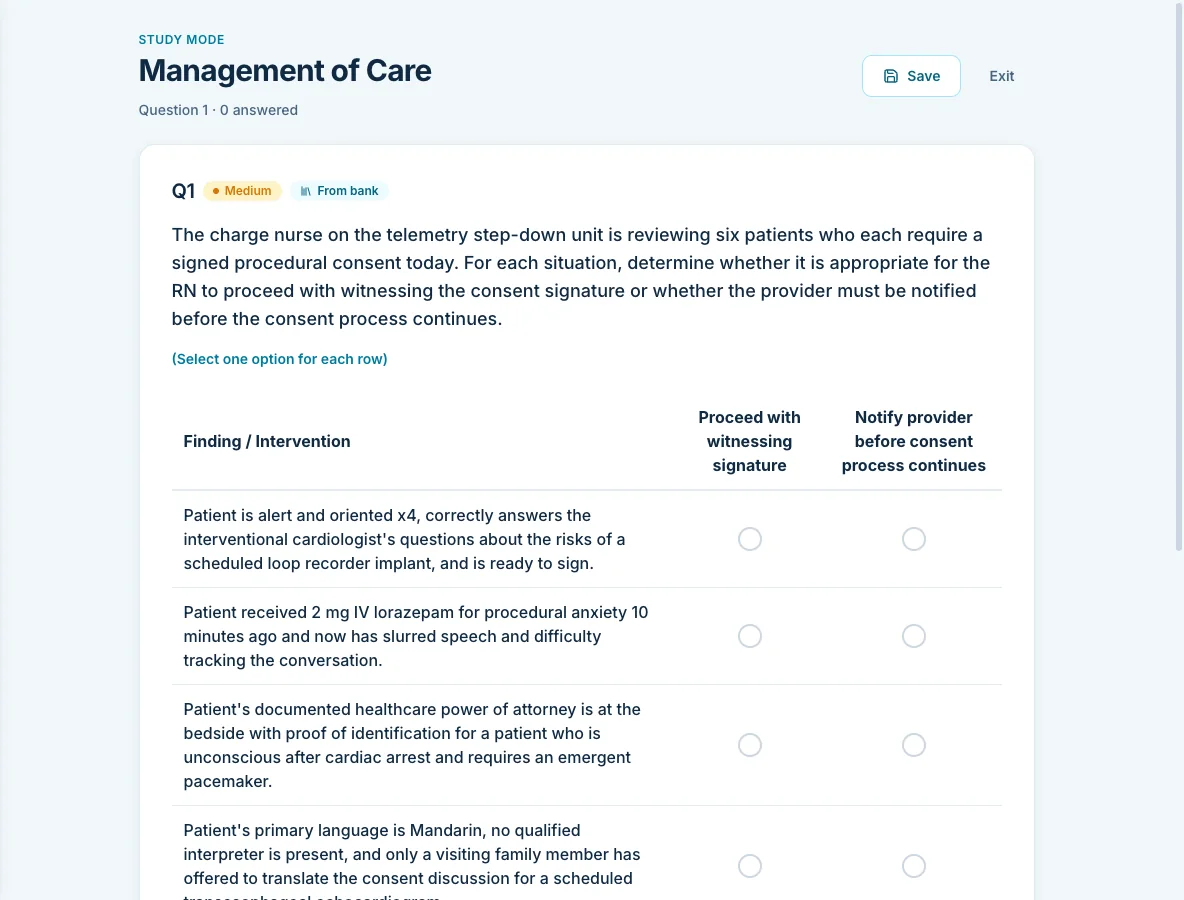
Determine the format of the question immediately. Is it a standard multi-select, a matrix grid, a drop-down rationale, or a drag-and-drop cloze? The question layout dictates the scoring rule.
Step 2: Apply the Plus-Minus Rule for Select All That Apply
Extended multiple response questions use the plus-minus rule. You earn plus one point for every correct option you select. You lose one point for every incorrect option you choose.
The total score for the question cannot drop below zero. If you select two correct options and two incorrect options, your net score is zero. Therefore, select only the options you are certain are correct.
Step 3: Handle Zero-One Items
Certain items use zero-one scoring with fixed selections. Drop-down lists, drag-and-drop items and matrix grids with one answer per row give one point per correct choice. Incorrect selections do not subtract points here. Matrix grids that let you tick several boxes in a row use the plus-minus rule instead. Do not leave these items blank.
Step 4: Connect Paired Logic in Rationale Items
Cause-and-effect questions use rationale scoring. A sentence contains two drop-down menus representing a condition and its physiological cause. You must select both parts correctly to earn the point. If either part is wrong, you receive zero points for that pair.
Step 5: Review Using Detailed Notes
Always review your practice item breakdowns. Compare your chosen options against the scoring rubric. Studying high-yield NCLEX study notes helps you master the nursing concepts behind these points.
Common mistakes to avoid (The Warning)
Many candidates fall into avoidable traps because of old test-taking habits. Awareness of these errors protects your point total.
The most dangerous habit is over-selecting options on extended multiple response items. In the past, candidates guessed extra choices hoping to hit the right ones. Under plus-minus rules, wild guessing destroys earned points.
Never pick an option unless you find clear supporting evidence in the client record. If you are certain of three options but unsure of a fourth, leave the fourth option unchecked. Protecting your earned points is safer than gambling on an unsure choice.
Another error is skipping drop-down fields. Drop-down menus and one-answer-per-row matrix tables do not penalize wrong answers. Leaving a drop-down blank forfeits a potential point with zero upside.
Finally, avoid ignoring paired dependencies in rationale questions. Candidates often rush the second half of a cause-and-effect item. Because both parts must be right, an incorrect rationale negates a correct primary finding.
Expert insight and what changes next (The Authority)
Measurement experts at nursing regulatory bodies designed partial credit to reflect real clinical environments. In actual practice, a nurse recognizes several findings correctly and might overlook another. The modern scoring model reflects this continuum of candidate ability.
The NCSBN establishes these scoring rubrics for candidates across both the United States and Canada. Provincial colleges of nursing in Canada rely on the same scoring standards. Standardized scoring ensures every candidate meets entry-level safety criteria.
Applying NGN partial credit scoring consistently rewards deliberate, evidence-based reasoning. When you review a client chart, evaluate lab values, vitals, and nurses notes systematically. Identify the cue, verify the finding in the chart, and commit your answer.
Mastering these scoring rules replaces anxiety with strategy. Treat every item as an opportunity to earn points, manage your selections carefully, and maintain steady progress through the exam.
Frequently asked questions
Can my score on an NGN question be negative?
No, an individual item score never drops below zero. Even if you choose more incorrect options than correct ones, the minimum score for that question is zero.
Do incorrect answers subtract points on all NGN questions?
No, point deductions only occur on questions scored with the plus-minus method. Drop-down questions and one-answer-per-row matrix items use zero-one scoring, where wrong selections do not deduct points. Matrix items that allow several boxes per row are scored plus-minus.
How does rationale scoring work on cause-and-effect questions?
Both parts of the paired relationship must be answered correctly to earn credit. If you get the cause right but the effect wrong, you earn zero points for that pair.
Should I guess on Select All That Apply questions under NGN rules?
You should only select options you know are supported by the client record. Because incorrect selections subtract points under plus-minus scoring, random guessing reduces your total score.
Get new insights as they publish
One evidence-checked article at a time, plus a free-trial link. No sequence, one click unsubscribes.